

If you’ve ever held a cup of bubble tea, I have, you can reminence about the swirls of milk, the shiny tapioca pearls, the irresistible sweetness. If you can, the you already understand why this drink has taken the world by storm.
Bubble tea, also called boba tea globally, has become one of the most beloved drinks around the world. With its creamy texture, bright colors, and chewy tapioca pearls, it’s fun, flavourful, and incredibly satisfying.
But as its popularity grows, so do the questions – Is boba tea healthy? What about the sugar content, is it too much? Or Can it be part of a balanced lifestyle?
This in-depth guide explores the ingredients, benefits, risks, and smart swaps to help you enjoy boba tea without harming your health, all through a balanced, evidence-based lens. Let’s Discuss!
What Exactly is Boba Tea?
Boba tea is reportedly originated in Taiwan in the 1980s and quickly spread across Asia, North America, Europe, and the Caribbean (Wei, 2023; https://www.britannica.com/topic/bubble-tea).
The traditional boba tea includes:
- A tea base (green, black, jasmine, oolong, etc.)
- Milk or non-dairy creamer
- Sweetener (simple syrup, sugar, flavored syrups)
- Tapioca pearls (chewy balls made from cassava starch. It is also the magical ‘boba’ of the tea)
Over time, sellers began adding fruit flavours, jellies, brown sugar syrups, puddings, and whipped creams, making modern boba much sweeter and richer than the original.
The typical nutritional profile of a standard 16-20 oz boba tea, can contain between 300-500 calories, 50 to 70 grams of total carbohydrates, of which 40 to 60 grams are sugars, just from the tapioca pearls alone (Min et al 2016).
This makes boba tea more like a dessert than a drink.
You can watch the video about boba tea via the link below:
The Sugar Story: Why Boba Tea Can Be a Problem
One of the biggest health concern with bubble tea is added sugar. This is because most commercial shops use, liquid sugar syrup, brown sugar syrup, condensed milk, fruit-flavoured syrup and sweetened creamers (Min et al 2016).
Some shops may use a few of these in just one drink, which tremendously increases the sugar content.
A single serving of boba can contain any where from 15 teaspoons of sugar, which typically doubles the daily limit recommended by health organizations (Min et al 2016).
Why Too Much Sugar Matters
High sugar intake has been linked to several health issues including, insulin resistance, higher risk of type 2 diabetes, weight gain, fatty liver disease, inflammation, increased risk of heart disease and even acne and skin issues (Ma et al 2002 ; Rippe and Angelopoulos, 2016; Centers for Disease Control and Prevention).
The World Health Organization (WHO) recommends that adults limit ‘free’ or added sugars to less than 25 grams per day (World Health Organization, 2015).
Yet many boba drinks deliver that much, twice as much in some cases, and this is just in one cup.
What About the Tapioca Pearls?
Tapioca pearls (or boba) are made from cassava starch, water and caramel. They provide the chewy texture which most people love, but nutritionally, they offer little to no protein, low or no vitamins or minerals, little to no fiber and is mostly just starch (Min et al 2016).
Further, a full serving of tapioca pearls often contains around high amounts of calories and carbohydrates.
This means that the tapioca pearls may serve to rapidly raise blood sugar and do not contribute to that feeling of fullness or satiety, making it easy to overconsume.
Does Boba Tea Have Any Hidden Additives?
Many bubble tea sellers use non-dairy creamers. Most non-dairy creamers may contain hydrogenated oils (trans fat), artificial flavours, thickners and preservatives (controversial in some cases).
Research has shown that trans fats may increase inflammation and raise the risk of heart disease, even when consumed in small amounts (Iwata et al 2011;World Health Organization).
Some syrups and toppings also contain:
- Food colorings
- Artificial sweeteners
- High-fructose corn syrup
These do not make boba tea in a sense “dangerous,” but they can accumulate over time, especially if consumed weekly or daily.
The Health Benefits of Boba Tea (Yes, There Are a Few)
Although bubble tea can be sugary, the drink also has potential benefits, mostly due to the tea base.
1. Tea Contains Powerful Antioxidants
This is due to the base of the drink which may include green, black, oolong, and jasmine teas. These teas are rich in polyphenols, catechins, flavonoids and EGCG (especially in green tea) (Khan and Mukhtar, 2018).
According to research, these compounds may help to reduce oxidative stress, lower inflammation, support heart health, improve brain function and protect the cells from damage (Huang et al 2018; Khan and Mukhtar, 2018).
2. Tea May Support Heart & Metabolic Health
Research shows that regular tea consumption may improve blood lipids, help with blood pressure management, and support insulin sensitivity (Meng et al 2019; Xu et al. 2020).
This does not cancel out the sugar in boba, but it shows that when made properly, bubble tea has a beneficial foundation.
3. Mood & Social Enjoyment Matter Too
Boba is often views as a ‘pasttime’ drink. As such, it is usually enjoyed with friends or as a “feel-good treat.”
This type of enjoyment is what researchers called ‘the psychological benefits.’ This type of enjoyment can help with a feeling of pleasure, connection, relaxation whichi can be meaningful to emotional and overall health (Pressman et al 2009 ; Su et al 2020).
Potential Health Risks of Boba Tea
Regular consumption of boba tea can lead to several health concerns. This is due largely to the typical ingredients. Here are a few health concerns raised:
1. Blood Sugar Spikes – This is due to the syrups, creamers and tapioca starch. High blood sugar can lead to long-term metabolic issues (Jaelani et al 2024;The Conversation, 2026)
2. Excess Calories – Many people underestimate boba calories, which can lead to unintentional weight gain ( Min et al 2016;The Conversation, 2026).
3. Poor Nutritional Value – Boba tea is usually high in sugar and starch but low relatively low in protein, fiber and overall micronutrients (Zubairi et al. 2023).
4. Chronic Inflammation – Excess sugar and some creamers may contribute to low-grade inflammation. Chronic low-grade inflammation has been associated with the development of many chronic diseases including (Zubairi et al. 2023).
5. Dental Concerns – Sugary drinks can contribute to cavities and enamel erosion (The Conversation, 2026).
Healthier Ways to Enjoy Boba Tea
You don’t need to give it up, just upgrade your order by practicing the following:
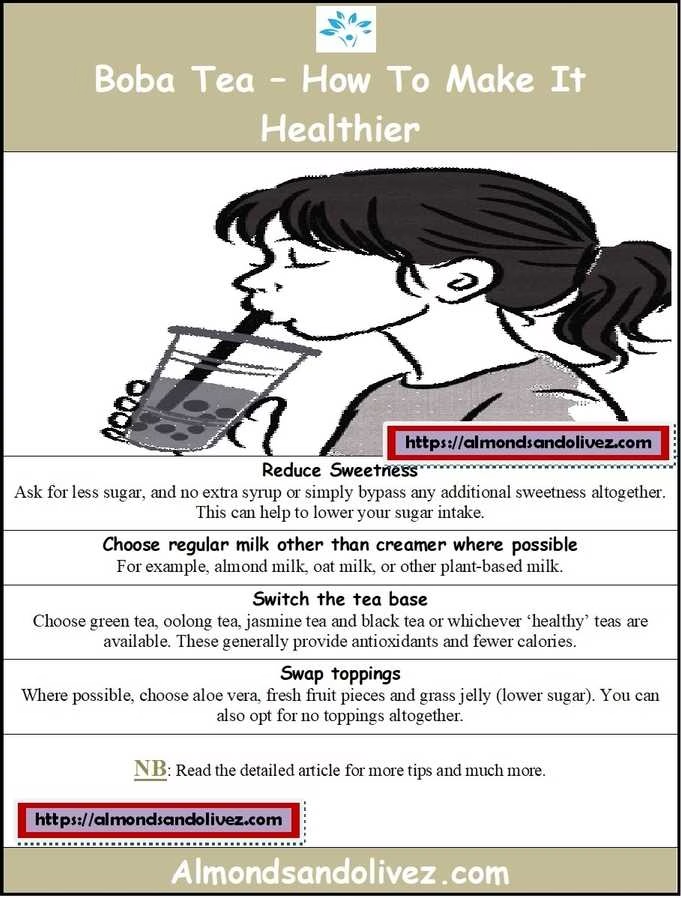
1. Reduce the sweetness – Ask for less sugar, and no extra syrup or simply bypass any additional sweetness altogether. This can help to lower your sugar intake.
2. Choose real milk instead of creamer – For example, almond milk, oat milk, or other plant-based milk.
3. Switch the tea base – Choose green tea, oolong tea, jasmine tea and black tea or whichever ‘healthy’ teas are available.These generally provide antioxidants and fewer calories.
4. Choose fewer pearls – In some cases, you can request half pearls, light pearls or pearls topping only. Just ask what is available and choose wisely.
5. Swap toppings – Where possible, choose aloe vera, fresh fruit pieces and grass jelly (lower sugar). You can also opt for no toppings altogether.
6. Pick the smaller size – Small cups can significantly reduce calorie intake.
7. Avoid dessert-style drinks – For example, brown sugar brulee, ice cream toppings and extra syrup drizzle. These often increase the amount of sugar.
Can Boba Tea Fit Into a Healthy Lifestyle?
Based on research, boba tea is not considered harmful when consumed occasionally. However, it can becomes a risk when:
- You drink it multiple times weekly
- You choose large or extra-large servings
- You select full sugar and heavy toppings
- You have existing blood sugar or metabolic concerns
For someone with diabetes or prediabetes, frequent boba consumption can cause blood sugar spikes. On the otherhand, the main concern for healthy adults is excess sugar and calories.
Can People with Diabetes or High Blood Sugar Drink Boba Tea?
Boba tea can be tricky for people with blood sugar issues because it typically contain high sugar, high refined carbs, low fiber and creamers and other ingredients that may increase inflammation.
However, you can make it safer by choosing less sugar or no sugar with light pearls, unsweetened green tea or black tea base, no syrup, no condensed milk, if available as well as choosing smaller size.
Even then, it should be consumed rarely, not regularly. Some people may even have to forego this treat, entirely.
Illustrative Summary
Here is an illustrative summary of BOBA TEA and Its Effects on the Body
Let’s Sum Up!
Boba tea is delicious, but it’s often underestimated as a dessert-level drink. It’s not “bad” or “toxic,” but it can contribute to excessive sugar intake if consumed often.
The good news is that you don’t have to give it up. Just make it a treat, not a habit, and choose healthier preparation options.
So, now that we have explored boba tea, its benefits, risks and how to incorporate it in a balanced, healthy lifestyle, will you? Or, have you every tried boba tea and how was it? Share it nuh!
Here are a few useful articles and free downloads that can help you on your journey of a healthier lifestyle.
- Video: Let’s Talk Boba Tea
- A Complete Vitamins Overview
- Podcast – Is Everything Inflammation?
- Podcast – Ultra-Processed Foods
- Podcast – The Blood Sugar Conversation
- Video – Must-Have Foods for Overall Good Health
- Free Download – Healthy Grocery Shopping List Guide
References and Further Readings
- Huang Y.W., Zhu Q.Q., Yang X.Y., Xu H.H., Sun B., Wang X.J., Sheng J. Wound healing can be improved by (-)-epigallocatechin gallate through targeting notch in streptozotocin-induced diabetic mice. FASEB J. 2018 doi: 10.1096/fj.201800337R.
- Iwata NG, Pham M, Rizzo NO, Cheng AM, Maloney E, Kim F. Trans fatty acids induce vascular inflammation and reduce vascular nitric oxide production in endothelial cells. PLoS One. 2011;6(12):e29600. doi: 10.1371/journal.pone.0029600. Epub 2011 Dec 28. PMID: 22216328; PMCID: PMC3247279.
- Jaelani, Mohammad & Larasati, Meirina & Prasetya Muninggar, Dian Luthfita & Wulandari, Desi & Rosidi, Ali. (2024). The Effect of Healthy Boba Pearl Drink on Post-Prandial Glucose. Jurnal Gizi dan Pangan. 19. 79-86. 10.25182/jgp.2024.19.2.79-86.
- Khan N, Mukhtar H. Tea Polyphenols in Promotion of Human Health. Nutrients. 2018 Dec 25;11(1):39. doi: 10.3390/nu11010039. PMID: 30585192; PMCID: PMC6356332.
- Ma X, Nan F, Liang H, Shu P, Fan X, Song X, Hou Y, Zhang D. Excessive intake of sugar: An accomplice of inflammation. Front Immunol. 2022 Aug 31; 13:988481. doi: 10.3389/fimmu.2022.988481. PMID: 36119103; PMCID: PMC9471313.
- Meng JM, Cao SY, Wei XL, Gan RY, Wang YF, Cai SX, Xu XY, Zhang PZ, Li HB. Effects and Mechanisms of Tea for the Prevention and Management of Diabetes Mellitus and Diabetic Complications: An Updated Review. Antioxidants (Basel). 2019 Jun 10;8(6):170. doi: 10.3390/antiox8060170. PMID: 31185622; PMCID: PMC6617012.
- Min JE, Green DB, Kim L. Calories and sugars in boba milk tea: implications for obesity risk in Asian Pacific Islanders. Food Sci Nutr. 2016 Mar 29;5(1):38-45. doi: 10.1002/fsn3.362. PMID: 28070314; PMCID: PMC5217910.
- Pressman SD, Matthews KA, Cohen S, Martire LM, Scheier M, Baum A, Schulz R. Association of enjoyable leisure activities with psychological and physical well-being. Psychosom Med. 2009 Sep;71(7):725-32. doi: 10.1097/PSY.0b013e3181ad7978. Epub 2009 Jul 10. PMID: 19592515; PMCID: PMC2863117.
- Rippe JM, Angelopoulos TJ. Relationship between Added Sugars Consumption and Chronic Disease Risk Factors: Current Understanding. Nutrients. 2016 Nov 4;8(11):697. doi: 10.3390/nu8110697. PMID: 27827899; PMCID: PMC5133084.
- Su, L., Tang, B., & Nawijn, J. (2020). Eudaimonic and hedonic well-being pattern changes: Intensity and activity. Annals of Tourism Research, 84, 103008. https://doi.org/10.1016/j.annals.2020.103008
- The Conversation. (2026, March 1). Is bubble tea bad for you? New research raises red flags. ScienceDaily. Retrieved July 10, 2026, from www.sciencedaily.com/releases/2026/02/260228093502.htm
- Wei, C. (2023, October 3). What is Boba Tea, Taiwan’s iconic drink? Travel. https://www.nationalgeographic.com/travel/article/what-is-boba-bubble-tea-taiwan
- Xu R, Yang K, Li S, Dai M, Chen G. Effect of green tea consumption on blood lipids: a systematic review and meta-analysis of randomized controlled trials. Nutr J. 2020 May 20;19(1):48. doi: 10.1186/s12937-020-00557-5. PMID: 32434539; PMCID: PMC7240975.
- Zubairi, Saiful & Mohd-Kasim, Zalifah & Zahiri, Muhammad & Faujan, Nur Huda. (2023). Health Concern of Phenomenally Premium Boba Milk Tea and Pearls Beverages in Kuala Lumpur: Sugary Content and Physico-chemical Profiles Analysis. Current Research in Nutrition and Food Science Journal. 11. 696-707. 10.12944/CRNFSJ.11.2.20.


 Jamaican Curry Rice Recipe: A Simple and Flavourful Side Dish