
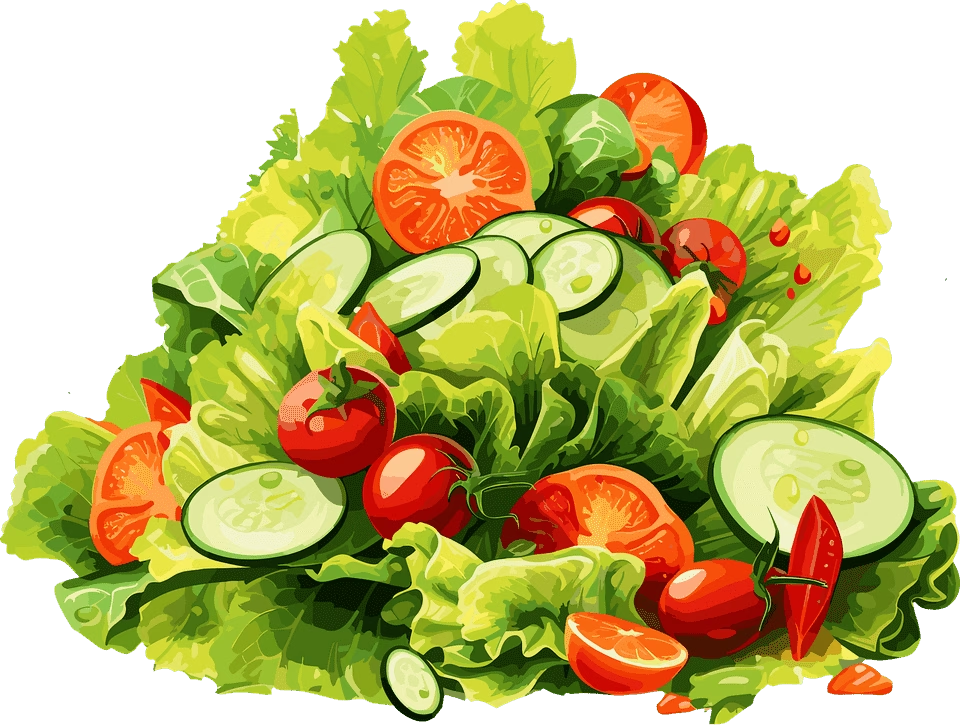
Lettuce is often viewed as a simple, everyday leafy green — but not all lettuce is created equal. While many people assume “lettuce is just lettuce,” there are actually numerous varieties, each with distinct textures, flavours, and nutritional profiles.
Research shows that there are over 100 species of lettuce worldwide, though only a handful are widely cultivated and commercially consumed. Among these, seven main types dominate grocery stores and home gardens due to their taste, versatility, and health benefits.
In this article, we’ll explore the 7 main types of lettuce, examine their nutritional value and health benefits, and discuss important cautionary considerations when consuming this popular leafy vegetable. Whether you’re building healthier meals or simply curious about what’s in your salad bowl, understanding the differences can help you make more informed food choices. Let’s Discuss!
Types of Lettuce
There are reportedly over One Hundred (100) species of lettuce in the genus or over Twenty-three thousand (23,000), according to Funk and Colleagues (Funk et al. 2005). However, research contends that formally, there are Seven (7) different types of lettuce (Mampholo et al. 2016). As such, this article will only explore these formally known types of lettuce, some of which are listed as most popular, globally.
You can find lettuce in different shapes and colours such as red lettuce, which is said to have more antioxidants and phenolic compounds than other varieties and colours (Wilson et al. 2004). It is also reportedly high in vitamin C and antioxidants (Medina-Lozano et al. 2021; Wilson et al. 2004).
In general, lettuce is no simple leafy green, even if it looks that way to some, as all varieties are considered nutrient-dense, comprising bioactive compounds such as polyphenols, carotenoids and chlorophyll, which has gained the name ‘ green blood’ due to its many potent health properties.
Lettuce is also a good source of quercetin (a flavonol), which has many beneficial effects on the body, such as boosting the immune system and thwarting infections. However, most of these compounds will depend on the variety and other genetic makeup of the respective lettuce (Gazula et al. 2007).
In Jamaica, you will mostly find only two (2) types of lettuce, Iceberg (Crisphead) and Romaine (Cos). However, Iceberg tends to be common, as you can find it in most Supermarkets, or markets in general.
In this article, we will explore seven (7) of the most popular types of lettuce. These are – Iceberg (Crisphead), Butterhead (Butter or Boston), Cos or Romaine, Stem (asparagus), Loose Leaf (cutting lettuce), Latin (a special type of butterhead lettuce) and Oilseed (Mampholo et al. 2016; Mousavi et al. 2003; Kristkovier et al. 2008). We will also discuss their nutritional benefits and storage tips, as well as any health risks.
You can read more on lettuce in general in this article:
Lettuce – Here are Three (3) Major Health Benefits and Health Risks.
Iceberg (Crisphead)
Iceberg (Crisphead) lettuce is one of the most popular among the different types. Crisphead (iceberg) lettuce has a tight and dense head, with its leaves usually spherical and folded together. It is called crisphead due to its often thick and crisp leaves. It is usually light green, but you may find them in mid-green, especially the more mature ones (Mitchell et al. 2002).
According to research, Iceberg lettuce is usually cultivated in the United States of America (USA) (Ryder 1996b; Mikel 2007). Nonetheless, you can find them being grown in abundance in Western and Central European countries like the United Kingdom and the Netherlands, etc. (Lebeda et al. 2007).
While it is often seen as the least nutrient-rich lettuce, Iceberg lettuce does pack a nutritional punch. For example, one cup is purported to contain about ten (10) calories and one (1) gram of protein with no fat. It also contains about two (2) grams of carbohydrates, fiber and sugar (1 gram respectively). Iceberg lettuce reportedly also contains about Seven (7%) percent of the daily recommended intake of vitamin A. It is also comprised of small amounts of iron and vitamin C (Lal et al. 2024).
Further, according to the United States Department of Agriculture (USDA), Nutrition Database, One Hundred (100) grams of Iceberg (Crisphead) Lettuce contains less than 1 (one) gram of protein and contains other nutrients such as calcium, magnesium, potassium, phosphorus, and sodium, with trace amounts of nutrients such as zinc, copper and manganese among others. It is also said to contain the fat-soluble vitamin, vitamin K (USDA, 2022).of wellness.
Loose Leaf (Cutting Lettuce)
Loose leaf (Cutting Lettuce) or simple Leaf lettuce because it has no heads, hence the name. However, this type of lettuce has many leaves in the center which can be curled or deeply lobed. This lettuce may sometimes be mistaken for Romaine lettuce due to its many leaves and size, but the leaves are usually softer than those of Romaine lettuce. Additionally, you may find many different shades of leaves for this type of lettuce, such as green, yellow-green and even red (Tony and Field, 2004; Mohamed et al., 2021).
Loose-leaf lettuce is purportedly rich in vitamin A and the B-vitamin, folate (Vitamin B-9). It also reportedly contains potassium, with small amounts of vitamin C and calcium. Nonetheless, like most other lettuce, it is low in fat, calories and sodium (aggie-horticulture.tamu.edu).
Romaine (Cos) Lettuce
Romaine (Cos) Lettuce. This is another popular lettuce, like that of Iceberg (Crisphead). Romaine lettuce has an oblong-shaped head, with leaves that are usually long and rigid. However, its leaves are upright and not folded (Rader and Karlsson, 2006). Additionally, the inner leaves may be green or green and white, with the outer leaves darker green (Simko et al. 2014). According to reports, this lettuce has a sweet flavour which distinguishes it from the other varieties (Simko et al. 2014).
Its name ‘Cos’ was named after the Greek Island ‘Cos (Kos), where it has long been cultivated (Křístková et al. 2008). According to research, this type of lettuce is most common in Mediterranean countries as well as Western Asia and North Africa (Ryder, 1986).
According to the United States Department of Agriculture (USDA), Nutrition Database, One Hundred (100) grams of Romaine (Cos) Lettuce contains 17 calories, no fat, cholesterol and sodium. However, you will find a few carbohydrates (1%), Dietary fiber, sugars (less than 2%), Vitamin C, iron, vitamin B6 (Pyridoxine), magnesium and calcium (USDA, 2019). It is also a good source of Zeaxanthin, which is excellent for eye health (Perry et al. 2009), as well as lutein, which is also good for eye health (USDA, 2016)
Butterhead (Butter or Boston) Lettuce
Butterhead (Butter or Boston) lettuce resembles that of its cousin, Iceberg lettuce. As such, they belong to the same family of lettuce and are sometimes just called simply ‘Crisphead’ lettuce. Its similarity to Iceberg lettuce is that it has a small head with spherical leaves. However, the butterhead lettuce leaves are not tightly woven like those of the Iceberg, which often differentiates the two relatives (Shi et al. 2022).
Additionally, Butterhead Lettuce usually has darker green outer leaves with the inner leaves lighter green due to its less exposure to the sun (Shi et al. 2022). Further, the leaves are usually smoother, shinier and oilier than those of Crisphead (Iceberg) lettuce. It is also said to have a butter-soft texture and mild flavour.
According to the United States Department of Agriculture (USDA), Nutrition Database, One Hundred (100) grams of Butterhead (Crisphead) Lettuce contains about 1.35 grams of protein, carbohydrates (2.23 grams), dietary fibers, less than 1 gram of sugars, calcium, iron, magnesium, phosphorus, sodium, potassium and trace amounts of some other nutrients. Some of these same nutrients can also be found in Iceberg lettuce (USDA, 2019).
Stem (Asparagus) Lettuce
Stem (Asparagus) Lettuce is reportedly grown in Europe and is less studied than most of the other mentioned types of lettuce (Malarz et al. 2020). Some reports also suggest that you will mostly find this type of lettuce in China than in Western countries (Lal et al. 2024).
This type of lettuce differs from the leaf lettuce as it has narrow leaves and edible stems. Hence, the reason it is called asparagus lettuce (Britannica.com). However, it is usually bitter. You may also hear it being called – celtuce, lettuce or Chinese lettuce due to its distinguished bitter taste and other characteristics. Stem lettuce can also be eaten raw like other lettuce, but it can also be cooked like asparagus (Lebede and KristKova, 1995).
This lettuce reportedly has narrow leaves with edible stems and is usually shaped like cabbage with its leaves folded into a compact head (Britannica.com). Stem lettuce’s nutrients are reportedly comparable to those of some of the other types of lettuce in that it contains vitamin A, folic acid, calcium, potassium, magnesium and an abundance of vitamin C (Murray et al. 2021).
Oilseed Lettuce
Oilseed Lettuce is a wild-looking plant that does not have any head or rosette of leaves, with a reportedly high oil content in its seeds (encyclopedia.com). This type of lettuce leaf is bitter and as such, it is often not eaten as a vegetable. Instead, it is mostly used for its seeds, which have a high oil content (Boukema et al. 1990). Its oil is high in vitamin E, which is a cherished antioxidant (Boukema et al. 1990). You will usually find this type of lettuce in Egypt, where it is often cultivated for its oil (Ryder, 1986).
Latin Lettuce
Latin Lettuce reportedly has a thick, leathery leaf and is usually dark green. It is also reportedly a special type of butterhead lettuce due to its buttery texture. Additionally, it is reported to resemble butterhead lettuce due to its disorganised rosette. However, the leaves are very thick and green (De Vries, 1997), similar to some extent to romaine lettuce due to its upright leaves.
Latin lettuce is usually eaten raw, like most of the other mentioned varieties (Rodenburg, 1960). Despite its name, Latin lettuce is mainly grown in Mediterranean countries as well as in North Africa and South America (Rodenburg, 1960).
Cautions About Eating Lettuce
While lettuce does have potent nutrients and health benefits, there are nutrients, or what are called ‘anti-nutrients’, which may serve otherwise. Anti-nutrients in general are compounds that can hinder the absorption of the nutrients of particular foods, and the same holds for lettuce (Shi et al. 2022). The main anti-nutrients that can be found in lettuce are nitrates. However, you can reduce its anti-nutrients by blanching, boiling, and soaking, among other methods.
You can read more about lettuce anti-nutrients in this article:
Lettuce – Here are Three (3) Major Health Benefits and Health Risks!
Lettuce Storage Tips
There are many ways you can store your lettuce to preserve its freshness and lengthen its shelf life. One such is storing it in a glass or plastic container or even a plastic bag (e.g. zip-lock bag). Just ensure that it is dry (if wet) by patting it with paper towels. Then line the container or plastic bag with some of the paper towels and add the lettuce to the top, or even covering it if desired. Then place it in the refrigerator. Lettuce is best used within a week.
Illustrative Summary
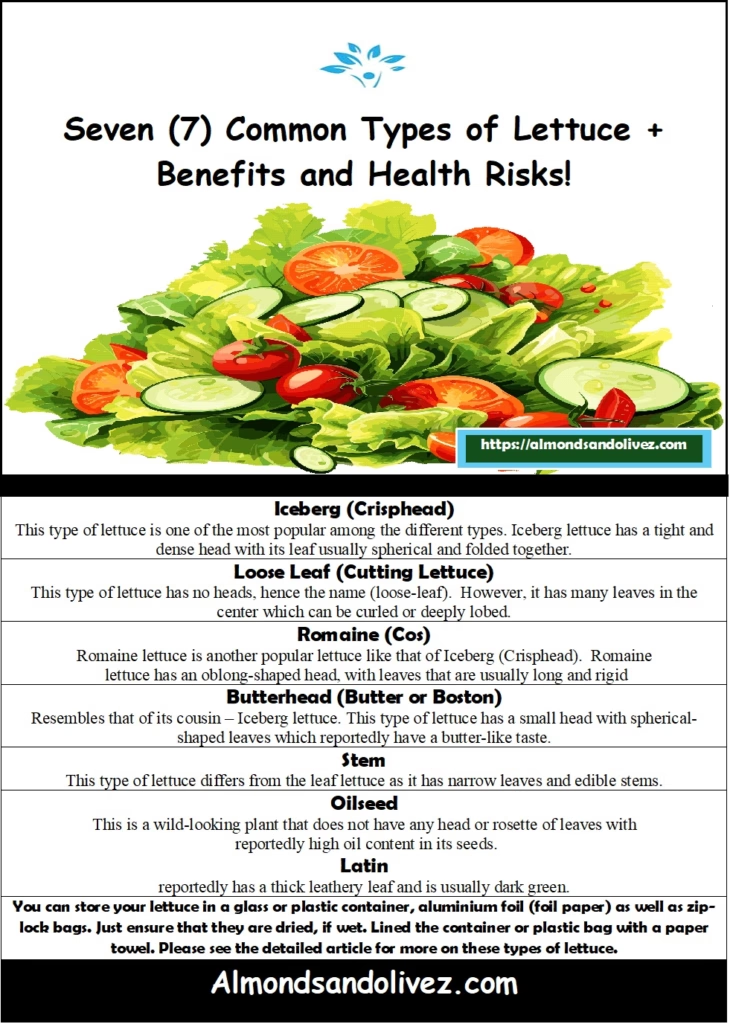
Here is an illustrative summary of the7 MAIN TYPES OF LETTUCE, Nutrients and RISKS.
Let’s Sum Up!
There are many different types of lettuce available commercially and globally. Research suggests that there are over One Hundred (100) or over twenty-three thousand (23,000) species of lettuce. However, some may be more available in different parts of the world than others.
In this article, we explored the seven (7) common types of lettuce. These include the famous iceberg and romaine. The other types of lettuce discussed were butterhead, loose leaf, stem, oilseed and latin. All these lettuces have varying nutrients, but most lettuce has similar nutrients, with some nutrients being more or less dependent on agricultural practices.
So, now that we have explored the different types of lettuce, which are you most familiar with? How do you enjoy your lettuce? Share it nuh!
You can read more on quercetin, lutein and other antioxidants that are reportedly beneficial for overall health in these articles:
- Lettuce – Here are Three (3) Major Health Benefits and Health Risks!
- A Simple and Inexpensive Lettuce Salad Recipe.
- Quercetin: A Powerful Flavonoid and Immune System Defender
- Wheatgrass Juice Powder – A Chlorophyll Powerhouse
- The ‘Pigly’ Truth about Nitrates and Nitrites
- Video: Let’s Talk Super Greens
References and Further Readings
- Boukema I.W., Hazekamp Th., Hintum Th.J.L van , 1990. The CGN Collection Reviews: The CGN Lettuce Collection.
- Wageningen, Centre for Genetic Resources: 2–5.
- De Vries IM (1997) Origin and domestication of Lactuca sativa L. Genet Resour Crop Evol 44:165–174
- Funk, V.A.; Bayer, R.J.; Keeley, S.; Chan, R.; Watson, L.; Gemeinholzer, B.; Schilling, E.; Panero, J.L.; Baldwin, B.G.; Garcia-Jacas, N. Everywhere but Antarctica: Using a supertree to understand the diversity and distribution of the Compositae. Biol. Skr. 2005, 55, 343–374.
- Gazula, A.; Kleinhenz, M.D.; Scheerens, J.C.; Ling, P.P. Anthocyanin levels in nine lettuce (Lactuca sativa) cultivars: Influence of planting date and relations among analytic, instrumented, and visual assessments of color. HortScience 2007, 42, 232–238. [CrossRef].
- Křístková, E. & Ivana, Doležalová & Lebeda, A. & Vinter, V. & Novotna, Alzbeta. (2008). Description of morphological characters of lettuce (Lactuca sativa L.) genetic resources. Horticultural Science. 35. 113-129. 10.17221/4/2008-HORTSCI.
- Lal B, Bhandari S, Upadhyay A, et al. Lettuce: A dive into its nutritional value and economic significance. AGBIR.2024;40(2):954-956.
- Lebeda A., Křistkov a E., 1995. Genetic resources of vegetable crops from the genus Lactuca. Horticultural Science (Prague), 22: 117–121.
- Lebeda A., Ryder E.J., Grube R., DoleŽalovA I., KŘIstkovA E., 2007. Lettuce (Asteraceae; Lactuca spp.). In:
- SINGH R.J. (ed.), Genetic Resources, Chromosome Engineering, and Crop Improvement, Vol. 3, Vegetable Crops. Boca Raton, CRC Press, Tailor and Francis Group: 377–472.
- Malarz J, Michalska K, Stojakowska A. Stem Lettuce and Its Metabolites: Does the Variety Make Any Difference? Foods. 2020 Dec 29;10(1):59. doi: 10.3390/foods10010059. PMID: 33383824; PMCID: PMC7824169.
- Mampholo, B.M.; Maboko, M.M.; Soundy, P.; Sivakumar, D. Phytochemicals and overall quality of leafy lettuce (Lactuca sativa L.) varieties grown in closed hydroponic system. J. Food Qual. 2016, 39, 805–815. [CrossRef]
- Medina-Lozano, I.; Bertolín, J.R.; Díaz, A. Nutritional value of commercial and traditional lettuce (Lactuca sativa L.) and wild relatives: Vitamin C and anthocyanin content. Food Chem. 2021, 359, 129864. [CrossRef] [PubMed].
- MIKEL M.A., 2007. Genealogy of contemporary North American lettuce. HortScience, 42: 489–493.
- Mitchell, J.; Horwath, W.; Southard, R.; Baker, J.; Munk, D.; Hembree, K.; Klonsky, K.; DeMoura, R.; Miyao, G. Expansion of conservation tillage initiatives in California. In Proceedings of the California Plant and Soil Conference, University of California,Berkeley, CA, USA, 14 May 2002.
- Mohamed, S.J.; Rihan, H.Z.; Aljafer, N.; Fuller, M.P. The Impact of Light Spectrum and Intensity on the Growth, Physiology, and Antioxidant Activity of Lettuce (Lactuca sativa L.). Plants 2021, 10, 2162. [CrossRef] [PubMed].
- Murray, Jesse & Basset, Gilles & Sandoya, Germán. (2021). Nutritional Benefits of Lettuce Consumed at Recommended Portion Sizes. EDIS. 2021. 10.32473/edis-hs1416-2021.
- Perry A., Rasmussen H., Johnson E. Xanthophyll (lutein, zeaxanthin) content in fruits, vegetables and corn and egg products. J. Food Comp. Anal. 2009;22:9–15. doi: 10.1016/j.jfca.2008.07.006. [CrossRef] [Google Scholar]
- Rader, H.B.; Karlsson, M.G. Northern field production of leaf and romaine lettuce using a high tunnel. HortTechnology 2006, 16, 649–654. [CrossRef]
- Rodenburg C.M., 1960. Varieties of Lettuce. An International Monograph. Zwolle, W.E.J. Tjeenk Willink.
- Rubatzky V.E., Yamaguchi M., 1997. World Vegetables. New York, Chapman & Hall.
- Ryder E.J., 1986. Lettuce breeding. In: Bassett M. (ed.), Breeding Vegetable Crops. Westport, AVI Publishing Co.:
- 433–474.
- Ryder E.J., 1999b. Lettuce, Endive and Chicory. Wallingford, CABI Publishing.
- Santos, J.; Oliva-Teles, M.; Delerue-Matos, C.; Oliveira, M. Multi-elemental analysis of ready-to-eat “baby leaf” vegetables using microwave digestion and high-resolution continuum source atomic absorption spectrometry. Food Chem. 2014, 151, 311–316. [CrossRef]
- Shi, M.; Gu, J.;Wu, H.; Rauf, A.; Emran, T.B.; Khan, Z.; Mitra, S.; Aljohani, A.S.M.; Alhumaydhi, F.A.; Al-Awthan, Y.S.; et al. Phytochemicals, Nutrition, Metabolism, Bioavailability, and Health Benefits in Lettuce—A Comprehensive Review. Antioxidants 2022, 11, 1158. https://doi.org/10.3390/antiox11061158
- Soetan, K.; Olaiya, C.; Oyewole, O. The importance of mineral elements for humans, domestic animals and plants—A review. Afr. J. Food Sci. 2010, 4, 200–222.
- Simko, I.; Hayes, R.J.; Mou, B.; McCreight, J.D. Lettuce and spinach. In Yield Gains in Major US Field Crops; American Society of Agronomy: Madison WI, USA, 2014; Volume 33, pp. 53–85.
- Tony, N. Field lettuce production. NSW Agric. 2004, 2004, 1–16.
- US Department of Agriculture, Agricultral Research Service, Nutrient Data Laboratory USDA National Nutrient Database for Standard Reference. [(accessed on 15 March 2016)]; Available online: http://www.ars.usda.gov/ba/bhnrc/ndl [Ref list]
- Wang, C.; Riedl, K.M.; Schwartz, S.J. Fate of folates during vegetable juice processing—Deglutamylation and interconversion. Food Res. Int. 2013, 53, 440–448. [CrossRef]
- Wilson, P.; Morrison, S.; Hedges, L.; Kerkhofs, N.; Lister, C. Phenolics contribute significantly to higher antioxidant activity of red lettuce compared to green lettuce. In Proceedings of the XXII International Conference on Polyphenols, Helsinki, Finland, 25–28 August 2004; pp. 273–274

 Red Light Therapy and Metabolic Health – A Complete Guide