

I know from the title you might be under the impression that this article is going to be about one’s physique, right? Well, not today! This article is really going to be about the types of fats or lipids found in our foods. We will also look at its importance to the human diet, regardless of the negative publicity it has received over the years. Needless to say, several researchers have expressed the significance of fats in our diet, especially when it comes to certain types of fats, for example, monounsaturated and polyunsaturated.
Nonetheless, while research has suggested the importance of fats to our overall well-being, most of us are still critical of this macronutrient and refuse to add even a snippet of it to our diet, while others have heightened interest in ‘no-fat’ or ‘low-fat’ product choices.
As such, this article aims to highlight the benefits of fats to our diet, the sources of ‘good’ fat, as well as strategies on how to include this critical nutrient in our daily diet. Let’s Discuss!
What are Fats?
Fats are considered one of the three (3) major macronutrients, which are crucial to human nutrition. The other two (2) are – Protein and Carbohydrates. Macro-nutrients, in their simplest term are major nutrients that our body requires to keep it moving. A common feature of fats or lipids is that they can only be dissolved in water and, as such, are considered insoluble in water.
In addition, fat acts as an energy reserve for the body in that the body will burn fat to make energy when we need it, especially if we are not getting enough from our diet. In fact, fat supplies the body with nine (9) kilocalories per gram. Further, without fat, our bodies would not be able to transport the needed fat-soluble nutrients of vitamins A, D, E and K.
Fat is also a critical element of the cell membrane, as well as the internal fatty tissues that protect our vital organs from trauma and changes in temperature by providing padding and insulation. When we eat too much fat, that extra fat is stored in what is known as the adipose tissue, which is used up when the body is depleted of carbohydrates.
The adipose tissue, or ‘fat’, is a term used for loose connective tissue composed of adipocytes. The main role of the adipose tissue is to store energy in the form of fat, even though it also serves to cushion and insulate the body.
Understanding the Fats that are in our Food
When we hear the word “fat,” we often think of things to avoid, but the truth is that your body relies on healthy fats to protect your organs and absorb essential vitamins. The key is learning to distinguish between the fats that heal and the fats that harm. To build a balanced diet, we need to look closely at saturated, monounsaturated, polyunsaturated, and trans fats. By understanding how these different types of fat function in our food, you can make empowered choices that fuel your energy and support your long-term heart health.
How Fat Works!
During digestion, the body breaks down fats into what are called ‘fatty acids,’ which are then absorbed into the bloodstream. Fatty acids are classified into three (3) broad categories – Saturated, Unsaturated and Trans Fat. Saturated fats are mostly found in animal products such as meat and dairy, as well as in some plant-based sources such as coconut and palm oils. On the other hand, unsaturated fats are of two (2) types – monounsaturated and polyunsaturated. These fats are derived from vegetables and plant sources.
What are Saturated Fats?
Saturated fats are typically solid at room temperature and are most commonly found in animal products and some tropical oils. On a molecular level, these fats are “saturated” with hydrogen atoms, making them stable but also denser than their unsaturated counterparts.
While they were once labelled as purely harmful, modern nutrition suggests that the source of the saturated fat matters most. For example, the saturated fats found in highly processed meats are treated differently by the body than those found in whole foods like coconut oil or high-quality dairy. To maintain a heart-healthy diet, it is generally recommended to enjoy these fats in moderation, replacing them with unsaturated fats where possible to keep your cholesterol levels in a healthy range.
Common Sources Include:
- Red meats (beef, lamb, pork)
- Full-fat dairy (butter, cheese, whole milk)
- Tropical oils (coconut oil, palm oil)
- Commercially baked goods and fried foods
What are Unsaturated Fats?
These fats are often referred to as “healthy fats.” Unsaturated fats are typically liquid at room temperature and are primarily derived from plants and fish. Unlike saturated fats, their molecular structure contains one or more double bonds, which prevents the molecules from packing tightly together. This unique structure is exactly what makes them so beneficial for your body, as they help reduce “bad” cholesterol levels and provide essential fatty acids, like Omega-3s, that your body cannot produce on its own. Incorporating these into your diet is a key strategy for supporting heart health and reducing inflammation. There are two (2) main categories of unsaturated fats: monounsaturated fats and polyunsaturated fats.
Please see a breakdown of these two categories of unsaturated fats:
1. Monounsaturated Fats
These fats can be found in olives, olive oil, nuts and avocados. Studies have shown that monounsaturated fats can lower Low-density lipoproteins (LDL) – ‘bad cholesterol’ while maintaining High-density lipoproteins (HDL) – ‘good cholesterol.’ However, too much monounsaturated fat can lead to weight gain as it contains nine (9) kilocalories per gram of fat, as with its counterpart – saturated fats.
Nonetheless, unlike saturated and trans fat which causes our bodies to produce more Low-density lipoproteins (LDL) than it naturally requires, monounsaturated fats do not affect cholesterol levels in the same way and instead, do the reverse of reducing bad cholesterol levels in the blood. As such, research suggests that monounsaturated fats can inhibit the build-up of cholesterol in the body as well as reduce inflammation in the blood vessels, which in turn helps to lower blood pressure.
While the chemical structure is similar across the board, we categorize monounsaturated fats by the nutrient-dense foods they are found in. For example:
- Plant-Based Oils: The most famous source is Oleic Acid, found abundantly in extra virgin olive oil. Other great sources include canola, peanut, and safflower oils.
- Nut and Seed Butters: Fats derived from almonds, cashews, pecans, and macadamias are rich in monounsaturated bonds.
- Fruit-Based Fats: The Avocado is a unique fruit because it is primarily made of monounsaturated fat, specifically the kind that supports skin health and nutrient absorption.
- Animal-Based Traces: While mostly known for saturated fat, high-quality sources of beef and eggs also contain smaller amounts of monounsaturated fats.
2. Polyunsaturated Fats
These types of fats are found in foods such as safflower, sesame and soybean oils. In addition, polyunsaturated fats provide the infamous omega-3 and omega-6 fatty acids – essential fats that the body requires but cannot produce on its own. Here is a breakdown of the fats found in this category:
- Omega-3 Fatty Acids
These fatty acids are found mostly in oily fish such as salmon and trout, as well as in nuts and seeds. Research suggests that these essential fatty acids can protect against disease and inflammation as well as protect the body from chronic diseases such as diabetes, cancer and Alzheimer’s. The Heart Foundation recommends that adults consume between 250 and 500 mg of Omega-3 fatty acids daily to reduce the risk of heart disease.
However, persons with existing heart conditions should seek to consume 2 to 3 servings of 150 grams of oily fish weekly. This can also be achieved by supplementing with a product that can provide at least 1,000 mg of Omega-3. Omega-6 is also found to have the effect of decreasing one’s risk of heart disease when it is consumed in place of saturated and trans fats.
- Omega-6 Fatty Acids
These fatty acids can be found in foods such as nuts, seeds and some vegetable oils such as soybean and safflower. In general, unsaturated fats have the propensity to improve blood cholesterol levels and insulin sensitivity, decrease cardiovascular risk, and provide energy for the body. Nonetheless, like all other fats, monounsaturated and polyunsaturated kinds must be consumed in moderation to prevent adverse ill effects.
- Omega-9 Fatty Acids
While omega-9 is not as ‘talked about’ as omega-3 and 6, it is also a fatty acid that is vital to overall good health. However, while omega-3 and omega-6 are considered ‘essential’, meaning that they must be consumed through our diets due to the body’s inability to produce them on its own, omega-9 fatty acids are classified as ‘non-essential’ because they can be produced by the body. As such, it is the most abundant fat in most of our bodily cells.
Further, it provides similar health benefits, including the ability to improve insulin sensitivity and help to regulate inflammatory processes. Omega-9 can be found in foods such as peanuts, cashews, almond oil and olive oil. Nonetheless, the key is for us to find the balance and ensure that we do not go overboard in our consumption habits of these fatty acids.
Finding the Balance Between Omega-3, 6 and 9 Fatty Acids
Balance is everything, and while these fatty acids are essential for overall health, we must aim to find that balance, as some omega-6 fats may promote inflammation if consumed in excess. According to research, people tend to consume more omega-6 than omega-3, as omega-6 fats are widely added to most processed foods when compared to omega-3. Therefore, it is recommended that we seek to consume more omega-3 than omega-6 fatty acids and reduce our consumption of processed foods.
What are Trans-Fat or Trans-Fatty Acids
While saturated and unsaturated fats originate from our foods, Trans Fat is man-made and created by manufacturers through a chemical process which causes liquid oils to become hardened. Trans fat raises the body’s LDL (bad cholesterol) while lowering HDL (good cholesterol).
Trans fat is usually used in the world of business and profits to extend the shelf life of processed foods such as fries, cakes, cookies, crackers and doughnuts. As such, they are seen as being more harmful to health than saturated fats, as they can contribute to insulin resistance, which can lead to debilitating conditions like diabetes.
Therefore, if you see a food item with the term ‘hydrogenated’ or ‘partially hydrogenated oils,’ it is likely to contain trans fat. However, while hydrogenation converts all of the unsaturated fatty acids to saturated ones, partial hydrogenation only converts some unsaturated fatty acids to saturated solids; as such, the others remain unsaturated, but their chemical structure changes and are thus considered health-damaging trans fat.
Reportedly, manufacturers have had their way over the years in adding this harmful substance to their products. However, the Food and Drug Administration (FDA) no longer views artificial trans-fat as safe for human consumption. As such, businesses have been commissioned to cease their usage by the end of 2018. Companies that persist in adding Trans-fat to their products will be required to justify its safety. The onus is thus on us, as consumers, to ensure that we carefully read nutritional labels on the food we buy.
It is important to note that while product labels should indicate the percentage of trans fat on their products, currently, the law does not require this information to be written on products if a single serving contains less than 0.49 grams (less than 1%) of trans fat.
Therefore, a product indicating zero trans-fat may in reality contain traces of this harmful substance. So, be mindful of this tidbit and read, read and read some more when grocery shopping.
Illustrative Summary
Here is an illustrative listing of the TYPES OF FATS, their functions and common FOOD SOURCES.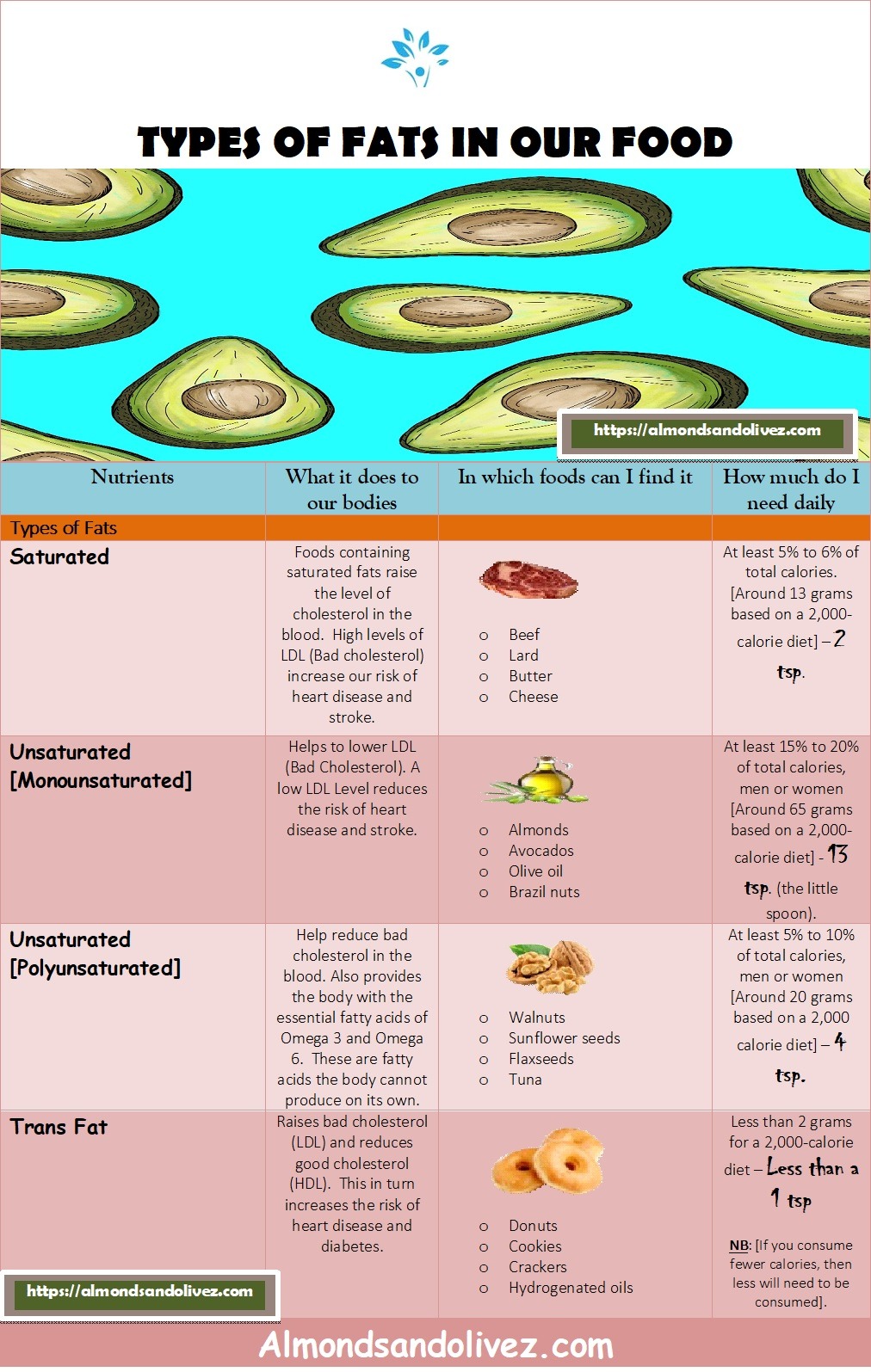
Let’s Sum Up!
Fat is an essential macronutrient that is required for good health. However, like all other nutrients, it must be consumed in moderation. There are three (3) major categories of fats: saturated, unsaturated and trans-fat.
Saturated fats are mostly found in animal products and are hardened at room temperature (e.g. lard and butter), while unsaturated fats are of two kinds – monounsaturated and polyunsaturated. We must seek to ensure that our diet is rich in essential unsaturated fats, such as monounsaturated and polyunsaturated and less trans-fat.
Unsaturated fats have been shown to help protect against heart disease, inflammation, and chronic diseases such as Alzheimer’s and diabetes. Unsaturated fats can be found in oily fish such as salmon, seeds, nuts and olive oil. However, while fat is an important component of the human diet, research has shown that high consumption of dietary fat is correlated with increased body fat as well as obesity.
Therefore, it is recommended that at least twenty to twenty-five (20-25%) percent of our total calories should come from fat. So, go ahead, drizzle it on (slowly) and enjoy some healthy fat, and reap the benefits.
Here is a food that is full of healthy fats and other essential nutrients. Plus a video on Chia Seed.
- Is Chia Seed Really an Omega-3 and Protein Powerhouse?
- Three (3) Awesome Health Benefits of Chia Seeds
- Video: Three (3) Awesome Health Benefits of Chia Seeds
- Video: Unlock Olive Oil Benefits: Avoid Fake Oil and Master Usage
References and Further Reading
- Astrup, A, et.al (2011). The role of reducing intakes of saturated fats in the prevention of cardiovascular disease: where does the evidence stand in 2010?
- Feldman M, et al. (2016). Digestion and absorption of dietary fat, carbohydrate, and protein. In: Sleisenger and Fordtran’s Gastrointestinal and Liver Disease: Pathophysiology, Diagnosis, Management. 10th ed. Philadelphia, Pa.: Saunders Elsevier.
Editor’s Note: This article was last updated by a Research Consultant and Certified Nutrition Coach on January 14, 2026

 Colour Me Cabbage – A Vibrant & Nutritious Turmeric Cabbage Recipe!