

Nitrates and nitrites are naturally occurring compounds made up of nitrogen and oxygen. They exist in both organic and inorganic forms and are widely used in agriculture, food preservation, and even certain medical applications. In processed and cured meats such as bacon, sausages, and bologna, nitrates and nitrites help preserve colour, enhance flavour, and prevent bacterial growth (Govari et al., 2018).
However, these compounds are not exclusive to processed foods. Nitrates also occur naturally in vegetables such as spinach, arugula, celery, lettuce, carrots, and beetroot (EFSA, 2008). In plants, nitrates are absorbed from soil as nutrients and play a role in growth and protein synthesis (Panos, 2008).
When consumed, nitrates can be converted in the body into nitric oxide, a compound that supports blood vessel function. Yet under certain conditions — particularly in processed meats exposed to high heat — nitrates and nitrites can form compounds known as nitrosamines, which have been associated with potential health risks.
Because of this dual nature, nitrates and nitrites are often misunderstood. In this article, we’ll explore the key differences between dietary nitrates and those used in processed meats and examine four important health risks linked to excessive intake. Let’s discuss!
What are Nitrates and Nitrites?
Nitrates and Nitrites which function as preservatives in processed or cured foods, have been a controversial subject over the years. This is especially due to the potential formation of nitrosamines, which is the substance that are formed when nitrates are used in high concentrations in foods that are then cooked at high temperatures.
This usually occurs in the case of processed or red meat, which usually requires high heat for cooking penetration (Kuhnle and Bingham, 2007). Nitrosamines are generally considered carcinogenic (Agency for Toxic Substances and Disease Registry, 1989). As such, their consumption can cause the body to become toxic, which can lead to the development of certain cancers.
One of the principal uses of nitrates dates back more than Fifty (50) years and was generally used as fertilizers in agriculture. However, its use in agriculture accelerated in the 1950s to what it is today (Ward, 2009). This was particularly due to its ability to be soluble in water. Nitrate fertilizers include ammonium, sodium, potassium and calcium salts. However, over the years, its usage has spanned from being used on crops to being chemically produced and used in food products as well as in drinking water.
While nitrates consumed in high amounts can cause severe health effects in humans, recent research has indicated their beneficial effects on health when it is consumed in reasonably low amounts. Some of the benefits include the lowering of blood pressure as well as cardiovascular health (Lundberg et al, 2006; 2011).
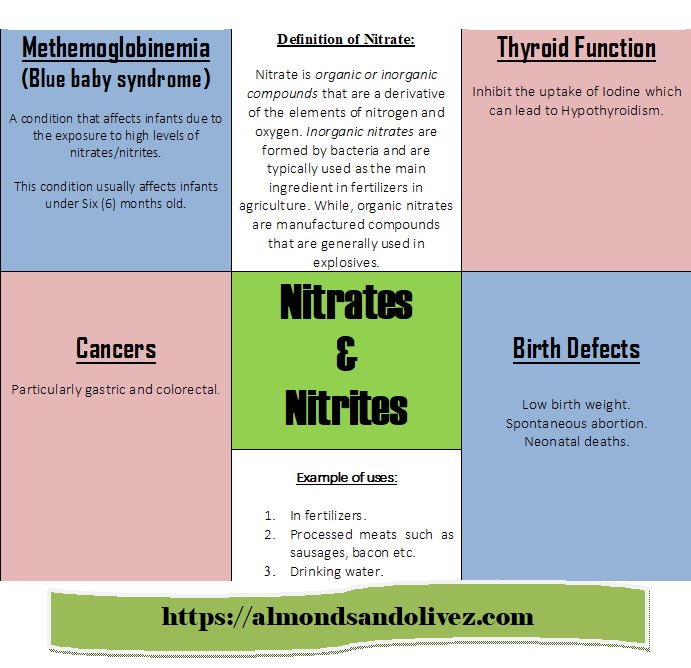
While the controversy continues, here are four (4) reasons to seriously reconsider consuming foods, particularly processed, with these ingredients. These include the development of Methemoglobinemia or ‘blue-baby syndrome, cancer, particularly gastric cancer, thyroid function issues and birth defects. The article will also discuss the differences between nitrates and nitrites, substances that are most often used interchangeably as well as misunderstood.
Four (4) Reasons to Avoid Nitrates and Nitrites.
- It may cause Blue-Baby syndrome.
- May cause the development of certain types of cancers.
- It may cause thyroid issues.
- May cause birth defects.
Nitrates and Methemoglobinemia or ‘Blue-Baby Syndrome
While nitrates are usually found in processed foods, it is also found in drinking water that has been contaminated with high levels of the substance. This, in effect, can cause a condition known as methemoglobinemia or blue baby syndrome.
Methemoglobinemia is a condition that occurs in infants under six (6) months of age as a result of the body’s inability to deliver the required levels of oxygen to the body (Ward et al., 2005). This usually happens when infants are exposed to high levels of nitrates, usually via elevated levels in drinking water (Ward et al., 2005). This condition has been documented for more than Fifty (50) years worldwide ever since the first diagnosis in 1945 (Environmental Working Group -EWG).
The first mention of methemoglobinemia’s association with high levels of nitrates in drinking water was reported in 1945 by Hunter Comly, who was a pediatric resident in Iowa City. The report concurred that infants who ingest water that was contaminated with high levels of nitrates were likely to develop this condition, particularly those who were experiencing gastrointestinal disturbance (Comly 1945; Fan et al. 1987).
Research has shown that any concentration of nitrates above Fifty (50%) percent in drinking water can result in death. As such, the Environmental Protection Agency in the United States has set the maximum contaminant level at 10 mg/L or 10 ppm (parts per million), especially when it comes to the contaminant levels in drinking water. Above this level, nitrates can cause severe toxicity to humans (Toxicology Committee, 1995).
Nonetheless, research has found that even levels below 10 ppm can be harmful to humans, which can result in the development of methemoglobinemia (Sattelmacher, 1964; Simon, 1962). However, one must also take care to ensure that they do not consume untreated water in wells, which can be contaminated with nitrates due to the effects of manure, fertilizers or even septic tanks (Preboth, 2005).
While some studies have shown that nitrates above certain levels can affect infants, emerging research has raised significant scientific doubt as to whether there exists a causal link to blue baby syndrome (Avery, 1999; Addiscott and Benjamin, 2006). These researchers suggest that the condition ‘blue baby syndrome’ could be caused by several other factors, such as gastric upset, protein intolerance and heavy metal toxicity. However, they did note that, while these factors could be among the prominent factors, they did agree that nitrate may have played a minor role in the development of this condition.
Notwithstanding, the European Food Safety Authority states that consumer exposure to nitrates and nitrites was well within the safety limits for all population groups. However, the Authority did admit that children may be exposed to higher concentrations if their diet mostly comprises foods with nitrates.
Nitrates and Cancers, particularly Gastric and Colorectal Cancer
Cancer is a disease that can arise due to many factors, including environmental and lifestyle factors. However, an increasing number of researchers are finding a causal link between nitrates and the increased risk of cancers, particularly gastric and colon (Aarhus University, 2018). According to a study by Aarhus University in 2018, colorectal cancer is the third leading cause of cancer worldwide and the 1st in Denmark, which was particularly found to have high amounts of nitrates in its drinking water. According to the research, the risk of cancer arises when nitrate is converted to N-nitroso, a carcinogenic compound.
In the United States, the established maximum contaminant levels of nitrate in water are 10 ppm (EPA, 1991). However, while nitrates in vegetables may sometimes be in greater concentration than that of water, research indicates that it is still considered good for human health and beneficial and not harmful as in the case of water contamination (US EPA, 1991).
This was concurred by Ward et al. (2005), who stated that the intake of dietary nitrate is less likely to cause an increase in nitrosation compounds due to the presence of nitrosation inhibitors in vegetables such as vitamin C and other antioxidants. The ascorbic acid (Vitamin C) reacts with oxygen, by forming dehydroascorbate, thus reducing the amount of nitrites which could be oxidized to nitrates (Honikel, 2008).
Nonetheless, L’hirondel et al. (2006) argue that if the nitrate in drinking water is stated to be toxic if greater than 10 ppm, then the nitrates found in certain foods, particularly leafy vegetables, which are comparatively higher, would likely be toxic regardless of the presence of ‘so-called’ nitrosation inhibitors.
This argument seems to have been concurred (though not clearly) by Dang, Vu et al (1994), who expounded that the research of Ward et al (2005) has forgotten that the metabolism of nitrates in humans starts in the mouth via the salivary gland. As such, nitrate would be reduced to nitrites in the mouth and then to nitric oxide and nitrosating compounds, which can react with N-nitroso agents and thus lead to the development of specific cancers, reproductive issues and diabetes.
Therefore, while Ward et al. (2005) touted that nitrate in foods is healthier and beneficial to humans, L’hirondel et al (2006) believe that the substance is toxic even if ingested via food or drinking water. According to Lundberg et al. (1994), about 25% of nitrates are secreted in the saliva. However, according to Bartholomew and Hill (1984), the majority of the nitrates that the body absorbs are excreted in the urine, while a considerable amount is reabsorbed from the kidney as well as the salivary gland.
Notwithstanding the proponent’s studies, Ward et al. (2005) still theorized that Vitamin C and other dietary antioxidants inhibit nitrate ill-effects in humans, a point of view that was also shared by several studies, such as (Bartsch et al 1998; Mirvish et al. 1998; Vermeer et. al. 1999). Further, all of these studies contend that one’s risk of cancer increases with the consumption of drinking water contaminated with nitrates of 10 ppm or higher, especially for those whose diet consists mostly of red meat and low levels of vitamin C (De Roos et al., 2005). Nonetheless, research still indicates that the long-term effects of nitrates and nitrites in the diet can lead to the formation of carcinogens in the human body (Andree et al, 2010; Honikel, 2008).
Nitrates and Thyroid Function Issues
Studies have denoted that the ingestion of nitrate can inhibit the uptake of iodine and thus affect the normal functioning of the thyroid gland (De Groef et al, 2006). Iodine is an essential nutrient that helps to maintain brain and thyroid health. The findings of De Groef et al. (2006) were concurred by several studies, including one conducted in the Netherlands on a group of women. In this study, there was an increased prevalence of thyroid hypertrophy among women who consume water with high levels of nitrates (Van Maanen et al. 1996).
Conversely, those who consumed water with nitrate levels of less than 50 mg/L were not affected by this condition. Surprisingly, though, the research shows that women whose diets were prevalent with dietary nitrates had an increased prevalence of hypothyroidism but not hyperthyroidism.
Nitrates and Birth Defects
While high levels of nitrates are said to lead to certain types of cancers, research has shown that pregnant women who consume water that is contaminated with nitrates can experience varying birth defects ranging from fetal deaths to spontaneous abortion and even growth retardation (Ward et al, 2018). However, while several studies have found a positive relationship between drinking water with high levels of nitrate and birth defects (Centre for Disease Control and Prevention, 1996), other researchers have found no positive association (Aschengrau, 1989).
Even though these studies were conducted twenty (20) years ago and may be discounted by many, most recent research (Fan and Steinberg 1996; Manassaram et al. 200) still suggests that high doses of nitrates do have a toxic effect on reproduction. In addition, nitrates have also been found to be mutagenic and, as such, possess an even greater possibility of ill effects on the human body (Luca et al. 1987).
What is Processed Meat or Foods?
Processed meats or foods in general are those which have been modified to extend their shelf life and enhance their taste. As such, this alteration of the food changes how it looks and tastes. Some of the main methods of processing foods include smoking, curing (using nitrates and nitrites), and adding salt or some other form of preservatives. Processed meats include sausages, salami, ham, corned beef and bacon, among others. Some meat sauces also fall into this category; as such, you will have to ensure that you read the ingredients list of your food purchases.
Like so many other food ingredients, nitrates and nitrites have had their share of controversies over the years. One minute it is safe, and in another it is deadly. However, more and more research has been surfacing that has proven the latter. As such, this article will attempt to decipher some of these findings in an attempt to assist you in your quest for health and wellness.
Nitrates vs. Nitrites: What’s the Difference?
Nitrates and nitrites are often used interchangeably, but they are chemically distinct compounds with different roles in food and human physiology. Both occur naturally in the environment as part of the nitrogen cycle and are essential to plant growth and soil health. However, their biological activity depends on how they are converted and utilized.
In nature, nitrates are formed through atmospheric processes such as lightning and rainfall, which deposit nitrogen compounds into the soil. Soil microorganisms further contribute by breaking down organic matter, converting nitrogen into nitrate forms that plants can absorb and use for growth. These plant-derived nitrates are considered part of normal dietary intake.
When humans consume nitrate-rich foods, a portion of dietary nitrates is converted to nitrites by bacteria in the mouth via salivary circulation. In the stomach, nitrites may then be further reduced to nitric oxide, a biologically important molecule involved in blood vessel dilation and cardiovascular regulation (Honikel, 2004). However, under certain conditions, nitrites can also participate in the formation of N-nitroso compounds, which have raised health concerns.
In processed and cured meats, nitrates are either added directly or converted into nitrites through bacterial activity involving nitrate-reducing enzymes (Sebranek & Bacus, 2007; Hammes, 2012). Nitrites are responsible for the characteristic pink or reddish colour of cured meats and play a critical role in food safety.
Specifically, nitrites help inhibit the growth of harmful microorganisms such as Clostridium botulinum, prevent lipid oxidation (which causes rancidity), and contribute to flavour development (Pearson & Gillett, 1996). During meat processing, nitrates and nitrites may also form reactive intermediates such as nitrous acid and nitric oxide, which can function as oxidizing or nitrosating agents (Honikel, 2004).
Importantly, the potential formation of carcinogenic N-nitroso compounds can be significantly reduced when antioxidants such as vitamin C (ascorbic acid) or vitamin E (alpha-tocopherol) are included in the curing process (Parthasarathy & Bryan, 2012).
Therefore, while nitrates and nitrites serve important technological and biological functions, their health impact largely depends on the source, quantity consumed, and the conditions under which they are processed and metabolized.
Illustrative Summary
Here is a summary of the Four (4) reasons to avoid the consumption of foods with Nitrates and Nitrites.
Let’s Sum It Up!
Nitrates and Nitrites are compounds that are commonly used as additives in processed foods, particularly sausages, bologna, bacon and red meat in general. When used, nitrates and nitrites affect the quality of the food, help to kill bacteria and extend its shelf life. The controversy of nitrates and nitrites arises when they are converted to N-nitroso compounds, which are known to be carcinogenic.
Some of the potential health effects of consuming nitrates, particularly over 10ppm, which is the allowable amount, include methemoglobinemia or what is called ‘Blue baby syndrome’, cancers, particularly gastric and colorectal, thyroid dysfunction, as well as birth defects.
While recent research has contended that nitrates in high amounts are toxic to human health, some researchers have indicated that in small amounts, nitrates can be beneficial to one’s health, such as lowering one’s blood pressure and improving cardiovascular health.
Nonetheless, for meat products, many countries have set limits for nitrates and nitrites. The prevalent established limits are set to 10 ppm or less. The higher concentration is usually stated to cause toxicity and potential health effects.
The debates will certainly continue as the years go by, especially as people become more health-conscious about what they put in their bodies or even on their skin. However, it is always best to continue to do your research and not take any chances with your health. Without it, you are either living in pain or spending all you have to feel well or worse yet, dead.
You can read more on other foods that can help the body fight against diseases in these posts:
Is Ginger truly great for our health? Here are five (5) researched reasons that say it is.
Apple Cider Vinegar – The must-have product of any wellness pantry – Here are Five (5) reasons why!
- Beetroot – It’s more than a dietary nitrate powerhouse
- Video: Let’s Talk Beetroot
(First Published – September 15, 2019 – Updated – February 21, 2026).
References and Further Readings
- Aarhus University. “Nitrate in drinking water increases the risk of colorectal cancer, study finds.” ScienceDaily. ScienceDaily, 20 February 2018. <www.sciencedaily.com/releases/2018/02/180220095019.htm>.
- Addiscott, T.M, Benjamin, N. (2006). “Nitrate and human health”. Soil Use and Management. 20 (2), pp. 98–104. doi:10.1111/j.1475-2743.2004.tb00344.x.
- Andrée S, Jira W, Schwind KH, Wagner H, Schwägele F (2010). Review: Chemical safety of meat and meat products. Meat Sci 86, pp. 38–48.
- Aschengrau A, Zierler S, Cohen A. (1989). Quality of community drinking water and the occurrence of spontaneous abortion. Arch Environ Health, 44(5):283-90.
- ATSDR (Agency for Toxic Substances and Disease Registry). 1989. Toxicological profile for N‐nitrosodimethylamine. Prepared by the Syracuse Research Corporation for ATSDR in collaboration with the U.S. Environmental Protection Agency. U.S. Public Health Service, Washington, D.C. 119 pp.
- Avery, A. (1999). Infant Methemoglobinemia – Reexamining the Role of Drinking Water Nitrates. Environmental Health Perspectives, Volume 107, Number 7.
- Bartholomew B, Hill MJ (1984) The pharmacology of dietary nitrate and the origin of urinary nitrate. Food Chem Toxicol 22, pp.789-795.
- Bartsch H, Ohshima H, Pignatelli B. (1988). Inhibitors of endogenous nitrosation. Mechanisms and implications in human cancer prevention. Mutat Res, 202(2), pp.307–324.
- Comly, H.H. (1945). Cyanosis in infants is caused by nitrates in well water. JAMA 129,112–116.
- Dang Vu, Paul JL, Gaudric M, Guerre J, Yonger J, Ekindjian OG. (1994). N-Nitroso compounds, nitrite and pH in human fasting gastric juice. Carcinogenesis, 15, pp.2657–2659.
- De Groef B, Decallonne BR, Van der Geyten S, Darras VM, Bouillon R. (2006). Review: Perchlorate versus other environmental sodium/iodide symporter inhibitors: potential thyroid-related health effects. Eur J Endocrinol, 155(1), 17-25.
- DeRoos AJ, Ward MH, Lynch CF, Cantor KP (2003). Nitrate in public water supplies and the risk of colon and rectum cancers. Epidemiology.
- Environmental Protection Agency (2003). National Primary Drinking Water Standards (EPA-816/F-03–016), Washington DC, Office of Water. Available at: www.epa.gov/safewater.
- Fan AM, Willhite CC, Book SA. (1987). Evaluation of the nitrate drinking water standard concerning infant methemoglobinemia and potential reproductive toxicology. Regul Toxicol Pharmacol, 7(2):135–148.
- Fan AM, Steinberg VE (1996). Health implications of nitrate and nitrite in drinking water: an update on methemoglobinemia occurrence and reproductive and developmental toxicity. Regul Toxicol Pharmacol 23(1 Pt 1):35–43.
- Govari (Μ. ΓΚΟΒΑΡΗ, M & Pexara, Andreana. (2018). Nitrates and Nitrites in Meat Products. Journal of the Hellenic Veterinary Medical Society. 66. 127. 10.12681/jhvms.15856.
- Hammes, P.W (2012). Metabolism of nitrate in fermented meats: The characteristic feature of a specific group of fermented foods. Food Microbiol, 29:151-156.
- Honikel KO (2008). The use and control of nitrate and nitrite for the processing of meat products. Meat Sci 78:68-76.
- Kuhnle, G.G, Bingham, S.A. (2007). “Dietary meat, endogenous nitrosation and colorectal cancer” Biochemical Society Transactions, 35(5), pp. 1355-7.
- L’hirondel, J. L., Avery, A. A., & Addiscott, T. (2006). Dietary nitrate: where is the risk? Environmental health perspectives, 114(8), A458–A461. doi:10.1289/ehp. 114-1552029.
- Luca D, Luca V, Cotor F, Raileanu L (1987). In vivo and in vitro cytogenetic damage induced by sodium nitrite. Mut Res, 189:333–339.
- Lundberg JO, Weitzberg E, Lundberg JM, Alving K (1994). Intragastric nitric oxide production in humans: measurements in expelled air. Gut, 35:1543−1546.
- Lundberg JO, Carlstrom M, Larsen FJ, Weitzberg E (2011). Roles of dietary inorganic nitrate in cardiovascular health and disease. Cardiovasc Res , 89:525–532.
- Lundberg JO, Feelisch M, Bjorne H, Jansson EA, Weitzberg E (2006). Cardioprotective effects of vegetables: Is nitrate the answer? Nitric Oxide 15:359–362.
- Manassaram, D.M, Backer, LC, Messing, R, Fleming LE, Luke, B., & Monteilh, C.P(2010). “Nitrates in drinking water and methemoglobin levels in pregnancy: a longitudinal study”. Environmental Health. 9: 60. doi:10.1186/1476-069X-9-60.
- Mirvish, S.S, Grandjean, A.C, Reimers, K.J., et al (1998). Effect of ascorbic acid dose taken with a meal on nitrosoproline excretion in subjects ingesting nitrate and proline. Nutr Cancer, 31(2):106– 10.
- “Nitrates.” A Dictionary of Food and Nutrition. Retrieved June 28, 2019, from Encyclopedia.com: https://www.encyclopedia.com/education/dictionaries-thesauruses-pictures-and-press-releases/nitrates.
- ‘Nitrates’ (n.d). Retrieved July 13, 2019, from Collinsdictionary.com. https://www.collinsdictionary.com/dictionary/english/nitrate.
- Panos, S. (2008). In Handbook of Water and Energy Management in Food Processing. Woodhead Publishing Series in Food Science, Technology and Nutrition.
- Parthasarathy, D.K, Bryan, N.S. (2012). “Sodium nitrite – the cure for nitric oxide insufficiency.” Meat Science, 92(3), pp. 274-9.
- Pearson AM, Gillett TA (1996) Processed Meats, 3rd ed. Chapman & Hall, New York, NY.
- Preboth, Monica (2005-12-15). “AAP Clinical Report on Infant Methemoglobinemia”. American Family Physician. 72 (12): 2558.
- Sattelmacher, P.G. (1962). Methemoglobinemia from nitrates in drinking water. Schriflenr. Ver. Wasser Boden. Lufthyg., No. 21(in German).
- Sebranek JG, Bacus JN (2007) Cured meat products without direct addition of nitrate or nitrite: what are the issues? Meat Sci. 77:136–147.
- Simon, C., Manzke, H., Kay, H., & Mrowetz, G (1964). On the occurrence, pathogenesis, and possibilities for prophylaxis of the methemoglobinemia caused by nitrite. Z. Kinderheilkunde, 91: 124-138.
- Spontaneous abortions possibly related to ingestion of nitrate-contaminated well water–LaGrange County, Indiana, 1991-1994. Centres for Disease Control and Prevention (CDC). MMWR Morb Mortal Wkly Rep. 1996 Jul 5; 45(26):569-72.
- U.S. EPA (U.S. Environmental Protection Agency) 1991. National primary drinking water regulations, final rule. Fed Reg 56:3526–3597.
- Van Maanen JM, Welle IJ, Hageman G, Dallinga JW, Mertens PL, Kleinjans JC(1996). Nitrate contamination of drinking water: relationship with HPRT variant frequency in lymphocyte DNA and urinary excretion of N-nitrosamines. Environ Health Perspect. 1996 May; 104(5):522-8.
- Vermeer IT, Moonen EJ, Dallinga JW, Kleinjans JC, Van Maanen JM(1999). Effect of ascorbic acid and green tea on endogenous formation of N-nitrosodimethylamine and N-nitrosopiperidine in humans 3. Mutat Res, 428(1-2):353–361.
- Ward MH, deKok TM, Levallois P, Brender J, Gulis G, Nolan BT, VanDerslice (2005). Drinking-water nitrate and health–recent findings and research needs. J, International Society for Environmental Epidemiology. Environ Health Perspect,113(11):1607-14.
- Ward, M. H., Jones, R. R., Brender, J. D., de Kok, T. M., Weyer, P. J., Nolan, B. T. & Van Breda, S. G. (2018). Drinking Water Nitrate and Human Health: An Updated Review. International journal of environmental research and public health, 15(7), 1557. doi:10.3390/ijerph15071557.

 Cold Cocoa and Chia Seed Drink For Energy and Satiety