

If you have spent any time around fitness content lately, you have probably heard about Zone-to-zone cardio.
It seems to be everywhere and any attempt to get away from it, might just prove futile.
Walk, cycle or jog at a particular intensity. Keep your heart rate within a certain range. Stay there for 30, 45 or 60 minutes. And, according to some proponents, you may have just found the secret to better metabolism, improved fat burning and even healthier aging.
But is Zone 2 really the metabolic sweet spot it is sometimes made out to be?
Or has our enthusiasm for one particular exercise zone caused us to overlook something important?
The body responds to movement, intensity, duration, recovery and the overall training pattern. So, what actually is zone-to-zone cardio? What are the zones? What can we learn by going zone to zone rather than becoming obsessed with one particular zone? Is is something you are probably doing, but not in an officially way?. Let’s discuss!
You can learn more about cardio exercise by reading the article below:
What Exactly Are Exercise Zones?
According to exercise physiology, zone-to-zone cardio (formally known as intensity zone-based training) usually refers to exercise training using one’s heart rate.
As such, the exercise would be structured around specific percentages of your maximum heart rate, which is usually splite into five (5) distinct, targeted zones. (Esteve-Lanao et al., 2026).
Research contends that training zones may provide a valuable framework when it comes to the intensity ranges, which are usually based on one’s running speed or heart rate (Mann et al., 2013).
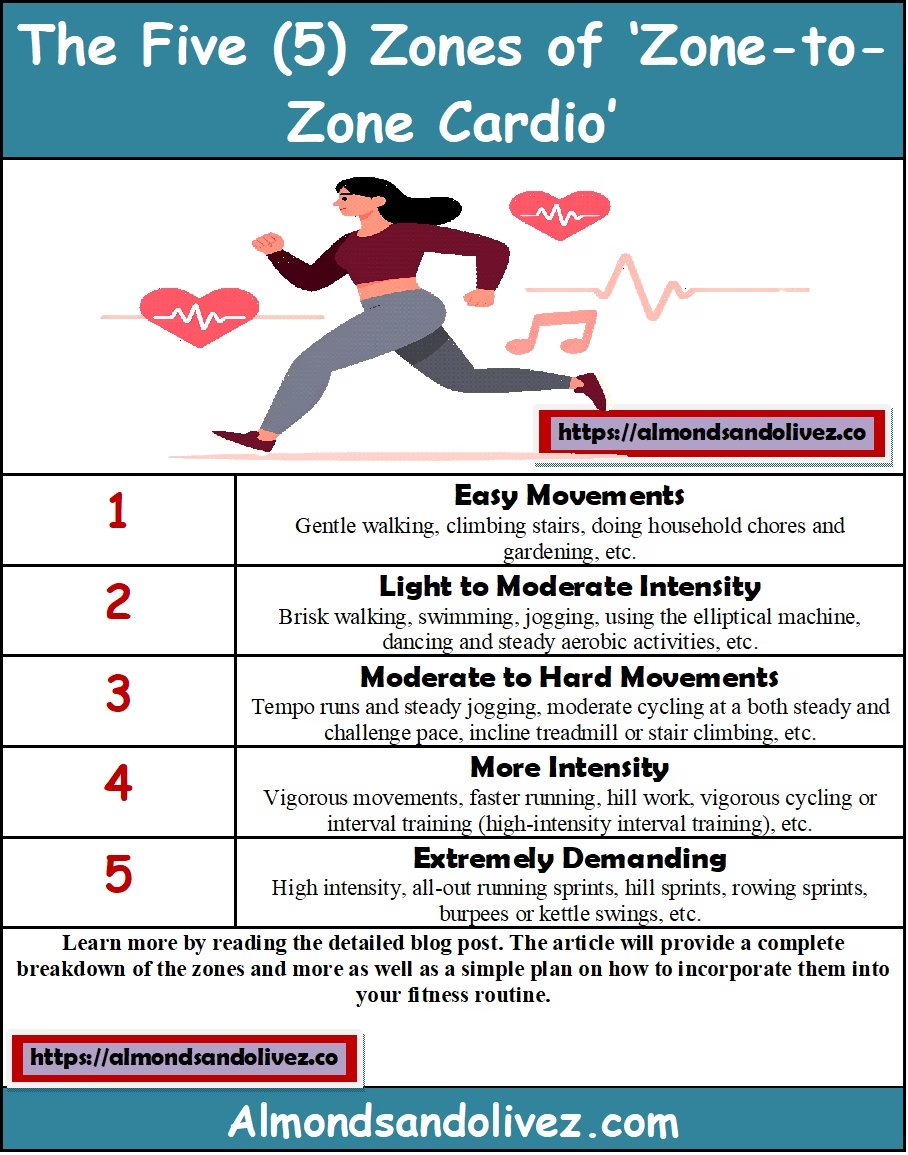
There are five (5) zones, with zone 1 being light movements and zone 5, vigorous movements. As such, the exercise movement intensifies from one zone to the next.
Exercise intensity describes how hard your body is working.
One common way of describing intensity is through heart-rate zones. Fitness watches and exercise programmes often divide heart rate into five zones, from very light effort to near-maximal effort.
The exact boundaries vary depending on the system being used, so these zones should be viewed as practical guides rather than rigid biological categories.
One of the more memorable takeaway of this method of exercising is the fixation on zone 2, which most fitness enthusiasts considere the ‘best zone.’
One should bear in mind though, that your zone 2 is not necessarily someone else’s. This is because fitness level, age, medications, temperature, level of fatigue and individual physiology call all influence heart rate and thus, exercise response (Esteve-Lanao et al., 2026).
So while heart-rate zones can be useful, they are not a set of universal numbers that determine whether your workout “counts.”
Please see the breakdown of the zones below.
Breakdown of the Zones
With the popularity of ‘zone-to-zone’ cardio, it is imperative that we know the different zones and what activities they entails.
Zone 1: Don’t Underestimate Easy Movement
This involves very light movement, think of leisure waying or gentle cycling. But, easy movements have value.
It also includes warm-ups and recovery. When in this zone, you should be able to breath comfortably and carry on a conversation without difficulty.
Movements of this nature can help you accumulate more physical activity without placing a large recovery demand on your body.
But remember, exercise and physical activity are not exactly the same thing.
Your daily walking, climbing stairs, doing household chores, gardening, dancing around the kitchen or walking to the shop all contribute to your overall movement.
The World Health Organization (WHO) emphasizes that physical activity can occur through transportation, work, household tasks, recreation and planned exercise, not just formal workouts (World Health Organization, 2020; 2024).
So if you are spending most of the day sitting and then trying to compensate with one intense workout, don’t overlook the value of simply moving more throughout the day.
You can learn more about walking and running, and how to incorporate them into your exercise routine in the articles below:
- So You ‘Wanna’ Walk – Here Are Five (5) Ways To Do It For Weight Loss
- So You ‘Wanna’ Run? Here Are Two (2) Major Health Benefits and Five (5) Ways To Run For Weight Loss
Zone 2: The Sustainable Workhorse
This is the zone that most people talk about. It involves light to moderate intensity.
This is usually described as comfortable, but purposeful aerobic effort. It focuses on brisk walking, easy cycling, swimming, jogging, using an elliptical, dancing, hiking or any other steady aerobic activity, depending on your fitness level
Zone 2-style cardio is attractive because it sits in that sweet spot of being challenging but sustainable (Clevelandclinic.org) https://health.clevelandclinic.org/zone-2-cardio
However, the exact activity is not really the point, it is the intensity that is relative to you.
For example, one person’s brisk walk could be another person’s easy stroll.
And this is why using perceived exertion and breathing can sometimes be more useful than obsessively watching the numbers on a smartwatch.
At moderate intensity, you should generally be able to talk but not sing comfortably. This is commonly referred to as the talk test.
Zone 2 can therefore be an excellent tool for building aerobic fitness and accumulating a meaningful amount of weekly activity.
But it does not have to be the only tool in your toolbox.
Zone 3: The Forgotten Middle
Zone 3 doesn’t seem to receive nearly as much attention. Perhaps because it’s not quite easy enough to feel effortless.
This zone involves moderate to hard movements. Your breathing will become noticeably heavier even though conversations is possible, but will become more difficult as you carry out the activities.
Zone 3 can provide a useful aerobic challenge, particularly for people who have already developed some fitness.
Examples of some of the movements of this zone – tempo run and steady jogging, moderate cycling at steady and challenging pace, swimming and incline treadmill walking or stair climbing, etc.
As intensity increases, your cardiovascular and respiratory systems have to work harder.
The important point is not that everyone needs to spend a certain amount of time in Zone 3.
Rather, different intensities create different physiological demands.
And that variability can be useful.
Zone 4: When You Turn Up The Intensity
Now we are getting into vigorous exercise, zone 4.
Zone 4 invovles more vigorous movements. For example, you may be doing faster running, hill work, vigorous cyclying or intervals. Talking in this this zone becomes difficult.
This is also the zone where where interval training often enters the conversation.
You might walk or jog easily for a few minutes, increase your pace for a shorter period, recover, and repeat.
Or you might cycle, row, run or use another activity that allows you to alternate harder and easier periods.
High-intensity interval training, or HIIT, has been studied extensively for its potential effects on cardiorespiratory fitness and metabolic health.
And the evidence continues to develop.
For example, a 2026 systematic review and meta-analysis examining HIIT in people with type 2 diabetes found improvements in cardiorespiratory fitness and several metabolic outcomes (Vieira et al., 2026).
Another 2026 meta-analysis looking at HIIT in real-world settings found improvements in cardiorespiratory fitness and cardiometabolic health outcomes, although the researchers also highlighted variation among studies (Stefanovic et al., 2026).
So yes, higher-intensity exercise has a place.
But that doesn’t mean everyone should suddenly start doing HIIT five days a week.
You can learn more about high intensity interval training in this detailed article:
Zone 5: More Is Not Automatically Better
Zone 5 is where exercise becomes extremely demanding.
This zone involves very hard movements. These movements are considered near-maximal or maximal effort. As such, they cannot be sustained for long.
For most people, this is not where the majority of their cardio should live.
And tha iss an important lesson. However, one must remember that, intensity is a tool, and not a prize or a trophy.
You don’t receive extra health points because you made yourself miserable during your workout.
Examples include all-out running sprints, hill sprints, hiit cycling intervals, rowing sprints, burpees or kettle swings and swimming sprints.
Higher-intensity exercise can be useful for appropriately trained individuals, but it also places greater demands on the cardiovascular and musculoskeletal systems and requires adequate recovery.
For someone new to exercise, returning after a long break, or managing a health condition, starting with easier activity and progressing gradually may be much more appropriate.
“According to clinical exercise models, heart rate zone training is not just about making a workout feel ‘easy’ or ‘hard’. It is a method of matching external workloads to internal metabolic thresholds. Research published in Sports Medicine demonstrates that staying strictly within specific lower zones optimizes cellular energy production, teaching the body to burn fat more efficiently while sparing valuable muscle glycogen stores.”
A Theory as to Why Zone 2 Has Become So Popular
There is a legitimate reason for the interest.
Aerobic exercise at a sustainable intensity can improve cardiorespiratory fitness and contribute to better cardiometabolic health. (Pinckard et al., 2019; American Heart Association).
Zone 2-style exercise also has an enormous practical advantage:
You can actually do it for a while.
You don’t need to sprint.
You don’t need to leave the gym feeling as if you’ve just survived an athletic competition.
You can walk, cycle, swim or use another form of aerobic exercise at a manageable intensity for a relatively long period.
Importantly, consistency matters.
The World Health Organization recommends that adults accumulate at least 150–300 minutes of moderate-intensity aerobic physical activity per week, or 75–150 minutes of vigorous activity, or an equivalent combination. Muscle-strengthening activities involving the major muscle groups are recommended on at least two days per week. (World Health Organization, 2020; 2024).
Notice something?
The recommendation does not say:
“Everyone must do Zone 2.”
It gives us a range of ways to be active.
So, Is Zone 2 the Best Zone for Metabolic Health?
Zone 2 has sometimes been presented as though it is uniquely capable of improving mitochondrial function, fat oxidation and metabolic health.
But a 2025 narrative review in Sports Medicine took a critical look at these claims.
The researchers concluded that the current evidence does not support Zone 2 as the uniquely optimal exercise intensity for improving mitochondrial or fatty-acid oxidative capacity in the general population. (Storoschuk , 2025).
They also pointed to evidence supporting higher-intensity exercise for improving cardiometabolic health, particularly when people have limited time available for exercise.
That is a pretty important distinction.
However, it doesn’t mean that Zone 2 is not effective, quite the opposite. What it means is that we should stop treating it as though it has exclusive rights to metabolic health.
What Does All of This Have to Do With Metabolic Health?
Quite a lot.
Metabolic health is much broader than the number on your bathroom scale.
It includes factors such as blood glucose regularion, insulin sensitivity, blood pressure, blood lipids, waist circumference and body composition, cardiorespiratory fitness, physical function and overall cardiovascular health (Myers et al., 2019 ; Blüher, 2020).
Exercise can influence several of these factors.
A systematic review and meta-analysis of randomized controlled trials found that exercise training improved cardiorespiratory fitness and several cardiometabolic biomarkers, including fasting insulin, insulin resistance measures and HbA1c (Lin et al., 2015).
This is one reason I prefer talking about metabolic health rather than making every fitness conversation about weight loss. You can become fitter, stronger and metabolically healthier without the scale changing dramatically.
The Metabolic Health Benefit Isn’t Just About Burning Calories
This is another area where fitness conversations can become overly focused on calories.
Most times, we tend to focus more on calories. Hence, one of the most known question – how many calories did I burn?
But, remember, your workout is doing much more than that. When working out, which including strength training, your muscles are contracting, your heart is pumping more blood, more lungs are responding to the increased demand, your blood vessels are adapting, your muscles are taking up glucose, and your cardiorespiratory system is being challenged.
Over time, repeated exercise can improve your body’s ability to perform these functions.
That’s why fitness itself is a health outcome.
The goal isn’t simply to burn off the food you ate.
It’s to build a body that is increasingly capable of handling physical demands.
Don’t Leave Strength Training Out of the Metabolic Health Conversation
Here’s where I think some Zone 2 discussions fall short.
Proponenets can make cardio sound like the entire metabolic-health story. But it isn’t.
Muscle matters.
Resistance training helps maintain and build muscle strength and mass, and skeletal muscle plays an important role in glucose disposal (Lee et al., 2017).
That’s why public-health recommendations pair aerobic activity with muscle-strengthening exercise (Zhang et al., 2024).
The World Health Organization (WHO) recommends muscle-strengthening activities involving the major muscle groups on at least two days per week.
As such, both cardio and strength is important for overall health.
A Zone-to-Zone Approach May Work Better
Rather than treating Zone 2 as the holy grail, think about building a range of movement and exercise into your week. For example:
Zone 1 / Easy Movement
Walking, gentle cycling, mobility work or other low-intensity activity.
Purpose: movement, recovery and increasing overall activity.
Zone 2 / Moderate Aerobic Work
Brisk walking, cycling, swimming or steady jogging.
Purpose: building aerobic capacity and accumulating sustainable cardiovascular exercise.
Zone 3 / Moderate-Harder Work
A stronger sustained effort.
Purpose: challenging your aerobic system and progressing fitness.
Zone 4 / Intervals
Shorter periods of vigorous effort separated by recovery.
Purpose: developing higher-intensity fitness and providing a time-efficient training stimulus.
Zone 5 / Very Hard Effort
Short, demanding efforts.
Purpose: generally more relevant to specific training goals than to something everyone needs to pursue for general health.
You do not necessarily need to deliberately train in every zone every week.
The point is simply that your body can benefit from different forms and intensities of movement.
What Might a Week Look Like
Let us make this a bit more practical.
A person who is already reasonably active might structure a week something like this:
Monday:
30–45 minutes of moderate aerobic activity.
Tuesday:
Strength training.
Wednesday:
Easy walking and general movement.
Thursday:
30–45 minutes of moderate aerobic activity.
Friday:
Strength training.
Saturday:
A more challenging cardio session, potentially including intervals.
Sunday:
Rest, recovery or an easy walk.
This is only an example.
It isn’t a prescription.
Your ideal routine depends on your fitness level, age, health status, preferences, schedule and goals.
Remember too, that you can break activity into smaller chunks, so that it fits your needs and meet your lifestyle.
What If You Don’t Have a Heart-Rate Monitor?
Don’t worry.
You can still exercise effectively.
The talk test and perceived exertion can provide useful information.
At moderate intensity, you should generally be able to speak but not comfortably sing.
At vigorous intensity, conversation becomes much more difficult.
You can also pay attention to your breathing and how hard the activity feels.
And this is particularly helpful because heart-rate measurements aren’t perfect.
Two people performing the same exercise may have very different heart-rate responses.
Reports also suggest that certain medications, over-the-counter drugs or even supplements can also alter heart rate (Gn et al. 2023; American Heart Association; Webmd.com).
What If You’re Starting From Almost Zero?
This may be the most important part of the entire article.
If you currently do very little physical activity, you don’t need to start by chasing Zone 2, or any other zone.
Start with movement you can manage.
Maybe that is a 10-minute walk, walking around the block, may it is a few short walks throughout the day or even danng to a couple of songs. Then gradually build from there.
The World Health Organization (WHO) guidance emphasizes that some physical activity is better than none, and recommends regular activity for adults.
So, you do not have to go from the couch to a perfectly structured five-day exercise programme.
Start where you are. Then progress.
You can learn more about how to get your fitness routine back on track after being inconsistent or sedentary for awhile. You can also listen to the podcast episode on how to get your fit on in 2025 and beyond.
- Podcast: Get your fit on in 2025 and Beyond
- Beyond the Resolution: 5 Proven Strategies for a Consistent Fitness Journey
A Note About Metabolic Conditions
Exercise can be particularly valuable for people dealing with metabolic conditions, but this is also where individualized guidance matters.
For example, people with diabetes may need to consider medications, blood glucose levels and the possibility of hypoglycemia depending on their treatment.
Someone with cardiovascular disease may need a different starting point.
And people with other chronic conditions may have specific exercise considerations. For example, those managing arthritis or joint pain.
So while general fitness guidance can be useful, your medical circumstances matter more than an exercise trend.
If you have a chronic condition, significant symptoms, or are returning to exercise after a prolonged period of inactivity, speak with an appropriately qualified healthcare professional about what is safe for you.
You can learn more about arthritis and joint pain, and even how exercise can help by reading the detailed article below as well as listen to the podcast episode about joint health:
- Podcast: Joint Health Matters: Protecting Mobility at Every Age
- Podcast: The Blood Sugar Conversation Everyone Should Be Having
- Arthritis Isn’t Just About Your Joints: What the Science is Revealing
The Bigger Picture: Exercise Is Not a Metabolic Hack
Maybe, this is where we can step away from the current fitness culture for a moment.
We are constantly looking for the next hack. The perfect heart-rate zone, the perfect workout, the perfect supplement, the perfect number of steps or the perfect time of day to exercise.
But metabolic health is not built around one magic variable.
It is influenced by the accumulation of behaviours over time.
Therefore, several factors must be taken into consideration. For example, your food pattern matters. your level of physical activity matters, your strength matters, your sleep matters, your stress and recovery matter, your overall cardiovascular fitness matters and your ability to maintain those habits matters.
You can learn more about sleep and stress, especially how they can affect our overall health and wellbeing in the podcast episodes below. You can also learn how to maintain your health and wellness within in 5 minutes or sticking to a healthy lifestyle even in busy times.
- Podcast: Can You Really Catch Up on Sleep Over the Weekend?
- Podcast: Sleepmaxxing – Optimizing Sleep Like a Hacker
- Podcast: Stress Is Normal – But What It’s Doing to Your Body Isn’t
- Podcast: 5-Minute Habits That Actually Work!
- Podcast: Eating Like You Care, Even When You Are Busy
A Researcher’s Perspective
Here’s my overall take.
I like Zone 2. But, I take all the zones into consideration when doing my exercise routines, especially strength training. Which I have been doing now for years.
However, I think zone 2 can be a practical, sustainable and accessible form of cardio for many people.
But I do not think we should turn it into another health rule that makes people feel as though they are exercising incorrectly.
Therefore, if you enjoy brisk walking, keep walking.
If you love cycling, cycle.
If you enjoy dancing, dance.
If you are ready for some intervals, and they are appropriate for you, add them.
If strength training is missing from your routine, make room for it.
And if you are currently inactive?
Start moving.
Your first goal does not have to be finding your ‘perfect’ Zone 2 heart rate.
Your first goal might simply be becoming a person who moves regularly.
Illustrative Summary
Here is an illustrative summary of the Five (5) Zones of ZONE-TO-ZONE CARDIO
Let’s Sum Up!
If your fitness tracker tells you that you’ve left Zone 2, do not panic.
You haven’t ruined your workout.
And if you never reached Zone 2 during today’s walk, that doesn’t mean your movement didn’t count.
Your body responds to the overall dose and pattern of physical activity, not simply whether a particular number appeared on your watch.
So move more.
Build your fitness gradually.
Challenge yourself when appropriate.
Strengthen your muscles.
Recover well.
And, most importantly, find movement you can live with, not merely exercise you can survive.
That is a much healthier way to think about cardio.
So, now that we have explored zone-to-zone cardio, where you surprise by any of the zones? Which zone/s you find you are doing mostly? Do you have a favourite zone? Share it nuh!
You can read more about exercising and its benefits as well as other exercises that can help you to lose weight, tone and strengthen the abs as well as start your fitness programme. Click the articles below:
- Podcast: Get your fit on in 2025 and Beyond
- Creating Your ‘HIIT’ Fitness Program
- 5 Best Exercise to do at Home to Strengthen and Tone the Entire Body
- Want Sexy Arms? Here is a list of Five (5) Exercises to give you that Tone and Sculpted Look
- Best Exercises to Strengthen and Tone the Thighs at Home
- What Are the Gluteus Muscles or Glutes? 5 Exercises to Strengthen, Tone and Shape Them
- The ‘Mighty’ Plank – One Exercise, Many Benefits
- Video: Why You Need to Exercise
References and Further Readings
- Blüher M. Metabolically Healthy Obesity. Endocr Rev. 2020 May 1;41(3): bnaa004. doi: 10.1210/endrev/bnaa004. PMID: 32128581; PMCID: PMC7098708.
- Esteve-Lanao J, Sellés-Pérez S, Arévalo-Chico H, Cejuela R. Towards Accurate Reference Values for Heart Rate and Speed Zones by Aerobic Fitness and Sex in Long-Distance Runners. Sports (Basel). 2026 Jan 7;14(1):29. doi: 10.3390/sports14010029. PMID: 41590971; PMCID: PMC12845794.
- Gn D, Patil M, Shafiq S. Drug-induced bradycardia. Clin Med (Lond). 2023 Mar;23(2):173-174. doi: 10.7861/clinmed.2022-0431. PMID: 36958845; PMCID: PMC11046544.
- Lee J, Kim D, Kim C. Resistance Training for Glycemic Control, Muscular Strength, and Lean Body Mass in Old Type 2 Diabetic Patients: A Meta-Analysis. Diabetes Ther. 2017 Jun;8(3):459-473. doi: 10.1007/s13300-017-0258-3. Epub 2017 Apr 5. PMID: 28382531; PMCID: PMC5446383.
- Lin X, Zhang X, Guo J, Roberts CK, McKenzie S, Wu WC, Liu S, Song Y. Effects of Exercise Training on Cardiorespiratory Fitness and Biomarkers of Cardiometabolic Health: A Systematic Review and Meta-Analysis of Randomized Controlled Trials. J Am Heart Assoc. 2015 Jun 26;4(7):e002014. doi: 10.1161/JAHA.115.002014. PMID: 26116691; PMCID: PMC4608087.
- Mann T., Lamberts R.P., Lambert M.I. Methods of Prescribing Relative Exercise Intensity: Physiological and Practical Considerations. Sports Med. 2013; 43:613–625. doi: 10.1007/s40279-013-0045-x. [DOI] [PubMed] [Google Scholar][Ref list]
- Myers J, Kokkinos P, Nyelin E. Physical Activity, Cardiorespiratory Fitness, and the Metabolic Syndrome. Nutrients. 2019 Jul 19;11(7):1652. doi: 10.3390/nu11071652. PMID: 31331009; PMCID: PMC6683051.
- Pinckard K, Baskin KK, Stanford KI. Effects of Exercise to Improve Cardiovascular Health. Front Cardiovasc Med. 2019 Jun 4; 6:69. doi: 10.3389/fcvm.2019.00069. PMID: 31214598; PMCID: PMC6557987.
- Stefanovic J, Werndle VV, Reljic D. Effects of High-Intensity Interval Training on Cardiorespiratory Fitness and Cardiometabolic Health in Real-World Settings: A Systematic Review and Meta-Analysis. Sports (Basel). 2026 Jul 22;14(7):311. doi: 10.3390/sports14070311. PMID: 42506854; PMCID: PMC13416871.
- Storoschuk KL, Moran-MacDonald A, Gibala MJ, Gurd BJ. Much Ado About Zone 2: A Narrative Review Assessing the Efficacy of Zone 2 Training for Improving Mitochondrial Capacity and Cardiorespiratory Fitness in the General Population. Sports Med. 2025 Jul;55(7):1611-1624. doi: 10.1007/s40279-025-02261-y. Epub 2025 Jun 25. PMID: 40560504.
- Vieira JPB, Carvalho VO, Aguiar LA, Smart NA, Monteiro CN, Weege MH, da Silva RP, Rangel BN, Gomes-Neto M. Effects of high-intensity interval training on cardiorespiratory fitness and metabolic outcomes in type 2 diabetes: A systematic review and meta-analysis. Clin Rehabil. 2026 Jul;40(7):871-892. doi: 10.1177/02692155261416862. Epub 2026 Feb 19. PMID: 41712410.
- WHO Guidelines on Physical Activity and Sedentary Behaviour. Geneva: World Health Organization; 2020. RECOMMENDATIONS. Available from: https://www.ncbi.nlm.nih.gov/books/NBK566046/
- Zhang L, Zhang B, Yuan W, Hu J, Yuan J, Wang X. Association Between Aerobic and Muscle-Strengthening Activities and Health-Related Quality of Life in Patients with Neck Pain: The National Health and Nutrition Examination Survey 2001-2004. J Pain Res. 2024 Nov 1; 17:3553-3564. doi: 10.2147/JPR.S484798. PMID: 39502791; PMCID: PMC11537042.


 A Pimple Here and Pimple There – The Science Behind Acne and a Simple Care Routine